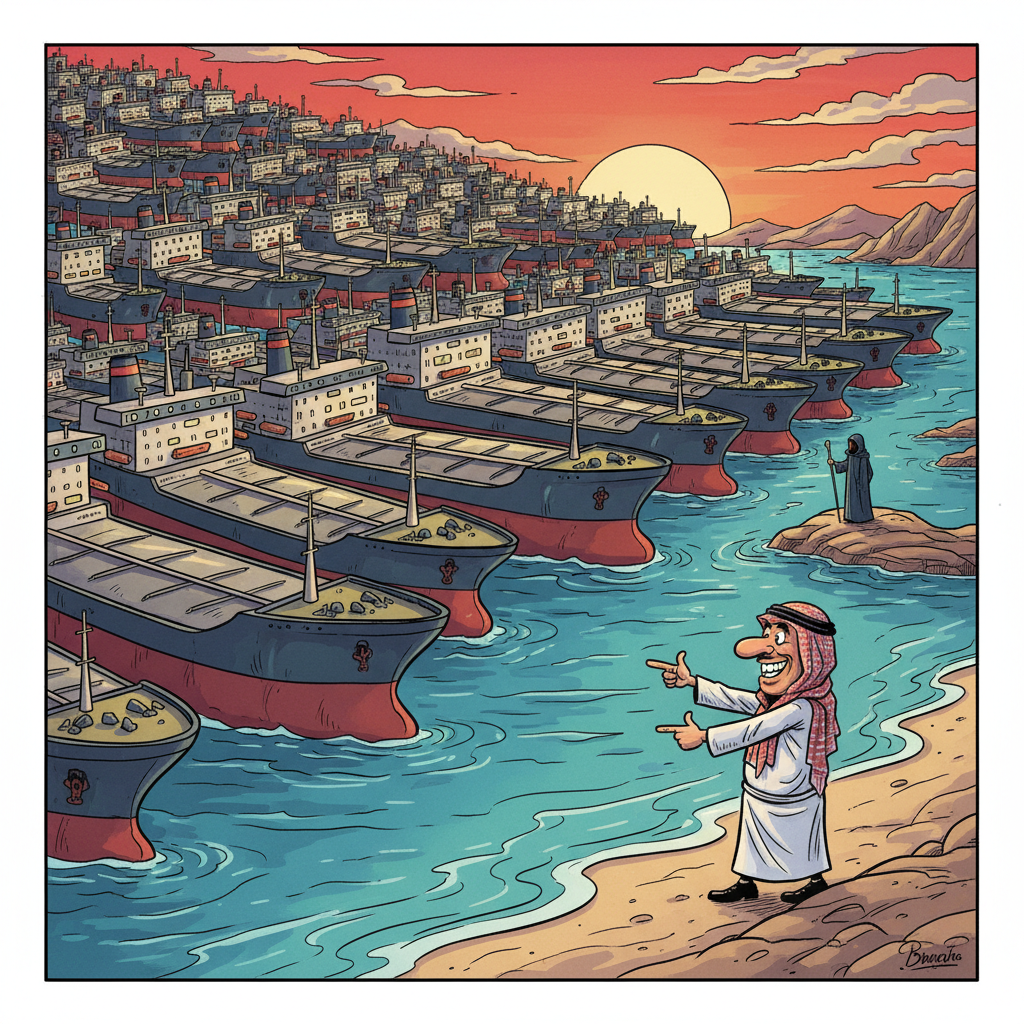
JEDDAH — Saudi Arabia’s ambitious new strategy to circumvent the Strait of Hormuz has entered its next phase, with officials confirming that the primary tactic involves accumulating an unprecedented number of oil supertankers off its Red Sea coast. The kingdom hopes that by sheer volume of vessels, a solution to its logistical challenges will spontaneously emerge.
“We’ve done the math, and it’s quite simple: more boats equals more oil moving, eventually,” stated Dr. Faisal Al-Hamad, Head of Maritime Logistics for the Saudi Ministry of Energy, speaking from a newly constructed observation deck overlooking a growing armada of idle tankers. “The Red Sea is vast. Our strategy is to fill it with so many ships that the oil practically trips over itself to get into them.”
Industry analysts, however, expressed confusion. “Usually, you load the oil onto the tanker, and then it goes somewhere,” noted maritime economist Brenda Chen. “This seems to be the ‘waiting for Godot’ approach to global energy supply chains. They have the oil, they have the port, but the actual act of loading appears to be a secondary concern to the aesthetic of a really big queue.”
The move comes as Riyadh scrambles to maintain oil exports amidst escalating regional tensions, which have made the traditional route through the Strait of Hormuz increasingly precarious. Sources close to the project suggest that initial plans included a complex system of pipelines and new port infrastructure, but these were ultimately deemed “too complicated” compared to the “just keep adding boats” solution.
Local fishermen have reportedly begun charging small fees for tours of the “Great Tanker Wall,” a new, albeit temporary, landmark visible from shore.