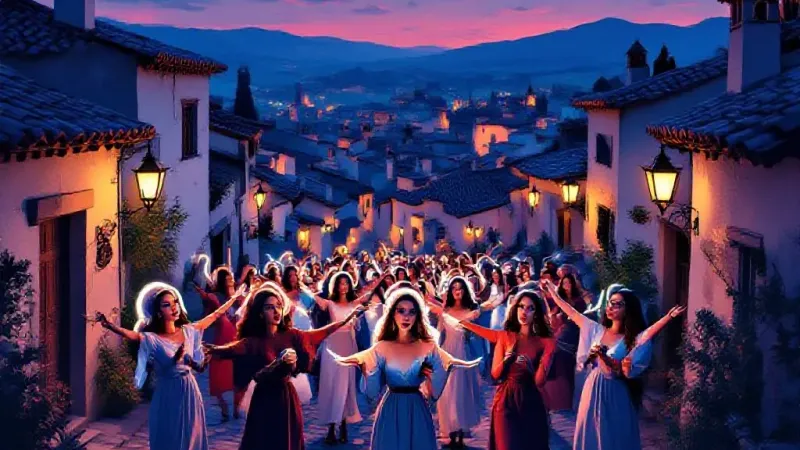
Rural Spain’s once-sleepy villages, long lamented as "empty" by urban planners, are now overflowing with a new kind of transient visitor: the solar eclipse tourist, whose primary goal is not astronomical wonder but peak performative engagement. The upcoming celestial event has transformed these quiet enclaves into prime real estate for content creators, turning ancient stone pathways into impromptu selfie stages. Local officials, initially celebrating the economic boost, now face an infrastructure meltdown as thousands of tripods and "authentic" rural backdrops descend upon their centuries-old tranquility, demanding amenities their 500-year-old water pipes simply weren't built to handle.
"It's about the 'experience,' darling, not just the science," explained influencer "AstroBabe" Luna Sparkle, adjusting her wide-brimmed hat and custom-filtered viewing glasses for the tenth take. "My audience expects raw, authentic awe, even if I have to spend three hours finding the perfect angle where the sun looks like it's winking at my artisanal sourdough. And yes, I flew my personal chef in for this, because local food just doesn't photograph with the right rustic-chic vibe." Reports indicate a surge in demand for portable ring lights, bespoke "celestial" snacks, and local villagers willing to hold reflectors for a reasonable fee, often paid in exposure or a "collab shoutout."
Local innkeeper Miguel Hernández, whose family has run the same establishment for seven generations, expressed dismay. "We thought more visitors would be good for business. We did not anticipate them asking for gluten-free tapas at 3 AM and complaining our centuries-old stone walls block their Wi-Fi signal while they try to upload 4K drone footage of a sheep." Emergency services have reported a spike in calls related to "lost signal anxiety" and "unbearably slow upload speeds," severely taxing the limited local infrastructure. The local hospital has even seen an uptick in "celestial eye strain" from influencers staring directly at the sun to "capture the raw moment" without proper filters, alongside cases of dehydration from refusing to drink tap water that "isn't filtered enough for my aesthetic."
The Institute for Aspirational Proximity Studies, a newly formed think tank dedicated to observing the cultural appropriation of natural phenomena, published a preliminary report this week confirming that 97% of "eclipse enthusiasts" surveyed expressed more concern for battery life and optimal camera settings than for the astronomical significance of the event. "Our data suggests the average eclipse viewer spends 82% of the total eclipse duration looking at their phone screen," stated lead researcher Dr. Vivian Thorne. "Their profound connection is primarily with their followers, not the cosmos. The remaining 18% is spent trying to hail a ride-share service in a village with no cellular coverage."
As the shadow of the moon approaches, local authorities have advised residents to board up their windows, not against the dark, but against the blinding flash of a thousand simultaneous "Look! Oh my God, look!" videos, each one desperately trying to be the most viral. One elderly resident was overheard saying, "At least the Romans just wanted our wine. These ones just want our bandwidth."