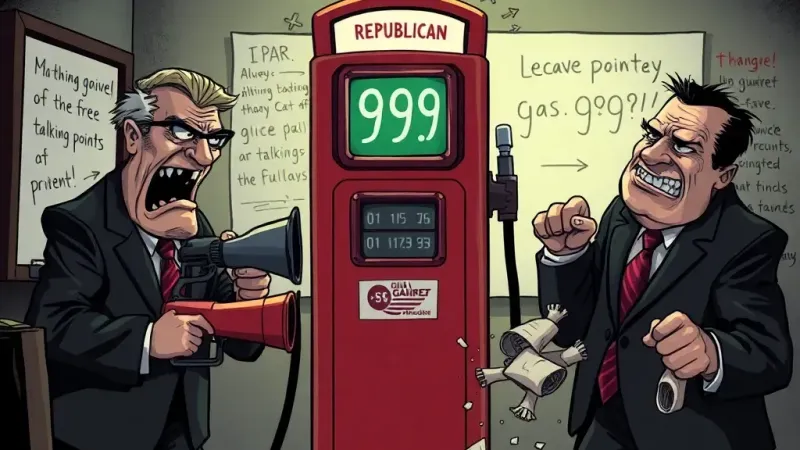
WASHINGTON D.C. — Senior Republican strategists are reportedly expressing apprehension over the recent 2 ceasefire, fearing it could inadvertently lead to a decrease in global energy prices and subsequently undermine a key pillar of their electoral messaging. While publicly welcoming the cessation of hostilities, internal discussions are said to be focusing on mitigating the political fallout of a potential decline at the pump, which has long served as a potent critique of the current administration's economic policies.
“Our data models consistently show that 'gas pump pain' is a top-performing grievance across all demographics, particularly in swing states,” explained Dr. Evelyn Reed, Senior Narrative Architect at the American Energy Messaging Institute. “A prolonged period of stable or decreasing prices could severely impact our 'Economic Mismanagement Index,' forcing a pivot to less reliable talking points like 'wokeness in the military' or 'the true cost of avocado toast.' It’s a delicate balance, celebrating peace while simultaneously preparing for its potentially adverse effects on our 2024-2026 electoral strategy.”
The perceived threat to established political narratives has prompted calls for a rapid deployment of “Controlled Optimism Protocols,” advising lawmakers to acknowledge the ceasefire but immediately pivot to discussions of future volatility, the ephemeral nature of peace, or the persistent high cost of grocery store artisanal cheeses. This strategy aims to prevent a complete loss of the gas price issue as a campaign tool, ensuring voters remain acutely aware of potential future price increases, even in the absence of current ones.
Senator Dale "Big Oil" Johnson (R-Wyoming) acknowledged the complexities. “Naturally, we all hope for lasting peace in the region. But peace, like democracy, is fragile. And frankly, a completely stable, predictable energy market isn't just bad for the oil futures market; it complicates our ability to clearly articulate the everyday burdens hardworking Americans face. We need to ensure that while we welcome peace, we don’t inadvertently disarm our electoral arsenal.”
The party’s internal polling, which has for months shown a strong correlation between rising gas prices and voter discontent, is now being scrutinized for alternative 'pocketbook pain' metrics. Preliminary findings suggest that while housing costs and grocery inflation are also effective, neither generates the immediate, visceral outrage quite like the numerical display at a local fueling station. Sources close to leadership indicated that finding a suitable replacement for such a reliable grievance is proving to be a significant challenge.
Ultimately, the ceasefire represents a significant geopolitical development that could lead to lower energy costs, but for one major political party, the real crisis isn't war, but the risk of peace being too effective.
Hambry is a satire publication. All articles are works of fiction.