

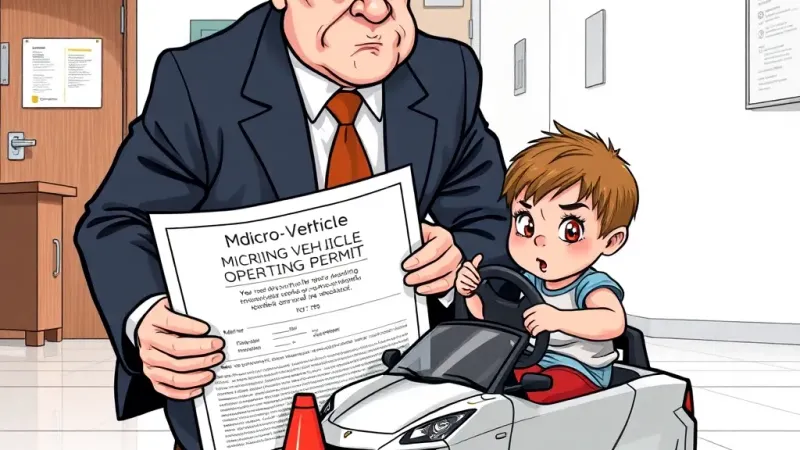
WASHINGTON D.C. — In a move long anticipated by parents and emergency room staff alike, the Federal Bureau of Vehicle Performance (FBVP) today announced a sweeping reclassification of all electric ride-on toys, effective January 1, 2026. Henceforth, products previously known as "Power Wheels" or "miniature Jeeps" will be officially categorized as "Class L-2 Micro-Vehicles," necessitating an entirely new regulatory framework, including mandatory micro-driver's permits and annual safety inspections. The decision comes after a multi-year study found that many high-end children's vehicles, originally designed for backyard use, are now routinely reaching speeds of up to 12 MPH and are increasingly equipped with features like all-wheel drive, Bluetooth-enabled sound systems, and even rudimentary GPS.
"For too long, these sophisticated personal transport devices have operated in a grey area of consumer product safety, falling between recreational items and actual motor vehicles," stated Dr. Evelyn Thorne, Director of Juvenile Mobility Standards at the FBVP. "Our data indicated an unforeseen operational creep, where what began as a quaint 3 MPH plastic car for grass lawns had evolved into an urban-capable, 400-watt, lithium-ion powered off-roader navigating sidewalks and sometimes, regrettably, public thoroughfares. We needed to bridge the 'toy-to-transportation' gap."
Under the new regulations, any ride-on toy capable of exceeding 5 MPH or weighing over 50 pounds will require its operator—or, in the case of minors, a parent or legal guardian—to complete an online "Micro-Vehicle Safety Course" and obtain a digital permit valid for two years. Manufacturers will also be mandated to install speed governors, audible alerts for proximity to non-motorized pedestrians, and standardized braking systems. The industry, predictably, is bracing for impact.
"We at 'Tot Rods Inc.' have always prioritized an uncompromised sense of freedom and adventure for our younger demographic," said Bjorn Andersen, CEO of Tot Rods Inc., makers of the popular 'Grizzly Tank XT.' "While we appreciate the FBVP's efforts to categorize what we’ve always seen as sophisticated, child-centric mobility solutions, we believe this overregulation stifles innovation. Our market research shows that 87% of children desire a seamless integration of off-road capability and neighborhood cruising, often without adult supervision interfering with their 'immersive driving experience.'"
Industry analysts predict a sharp decline in sales of high-performance models, while parents, many of whom have long treated their children’s electric vehicles as a form of early driver's education, expressed mixed feelings. "My little Timmy was just starting to master the drift turn in our cul-de-sac," lamented Sharon Price, a mother of three from Topeka, Kansas. "Now he needs a permit? This is going to set back his future NASCAR career by years. And where am I supposed to charge his 'Grizzly Tank XT' after the power output regulations kick in? My garage is already strained by my own e-bike."
The FBVP clarified that exemptions may be granted for vehicles strictly confined to private, fenced-off properties and operated solely under direct adult supervision, a caveat critics suggest will apply to approximately zero percent of current users. The agency hopes the new rules will "harmonize childhood vehicular aspiration with public safety realities." The new regulations aim to prevent further incidents by finally treating children's joyrides with the bureaucratic seriousness they increasingly deserve.