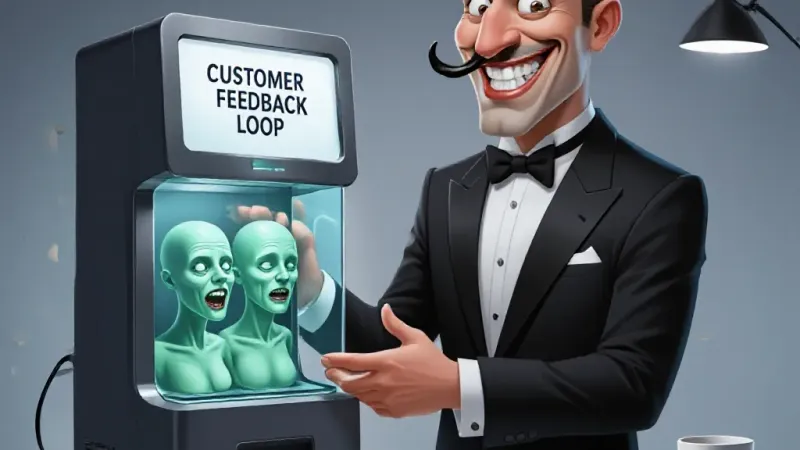
NEW YORK — The nation’s leading food conglomerates are quietly celebrating a banner year for product recalls, hailing the escalating number of contaminated items pulled from shelves as undeniable evidence of a “robust customer feedback loop” and an “optimized supply chain resilience strategy.” What many consumers view as a worrying trend of bacterial outbreaks and foreign objects, industry insiders are rebranding as "late-stage product engagement opportunities" designed to foster deeper brand connections.
"Frankly, these numbers are thrilling," beamed Horst Schnauzer, CEO of GlobalFoodCorp and chairman of the American Edibles Alliance for Shared Value, in a leaked internal memo obtained by Hambry. "Each recall isn't just a regulatory hurdle; it's a profound, visceral touchpoint with our most dedicated consumers. We're seeing unprecedented levels of post-recall brand awareness. People don't forget the salmonella incident from last quarter, do they? That's brand stickiness you can't buy with traditional advertising—it's earned through shared experience." He noted that the "negative publicity" often generates more social media impressions than any positive campaign.
The industry's shift in perspective comes after a series of internal reports revealed that the cost of preventing widespread contamination often outweighs the financial implications of recalls, especially when factoring in the "experiential marketing" benefits. "Our modeling shows that a well-executed recall, complete with swift public apologies, the strategic deployment of discount coupons, and a clear path for social media virality, actually drives higher repeat purchases than a consistently safe, unremarkable product," explained Dr. Mindy Thorne, a behavioral economist from the Institute for Aspirational Proximity Studies. "It creates a powerful narrative of corporate redemption, a shared journey where consumers feel like they're part of the solution, not just a potential victim. It's about turning a bug into a feature, literally."
Sources within the industry confirm that some companies are even exploring "recall gamification." Consumers who successfully identify tainted products—perhaps by developing foodborne illness—could earn loyalty points redeemable for future, potentially safer, groceries. The goal is to transform the anxiety of food safety into an interactive, brand-building experience, complete with leaderboards for "Top Contamination Detectors" and "Recall Resilience Badges" for those who experience multiple incidents and still return to the brand. "Think of it as crowd-sourced quality control, but with better PR optics," a marketing consultant for a major snack food producer told Hambry, on condition of anonymity to protect his "synergy initiatives."
This new strategy aims to streamline the entire product lifecycle, from farm to emergency room, ensuring every stage contributes to shareholder value and bolsters the corporate image. In the end, nothing fosters customer loyalty quite like the shared trauma of projectile vomiting from a breakfast cereal and then being thanked for the feedback.