
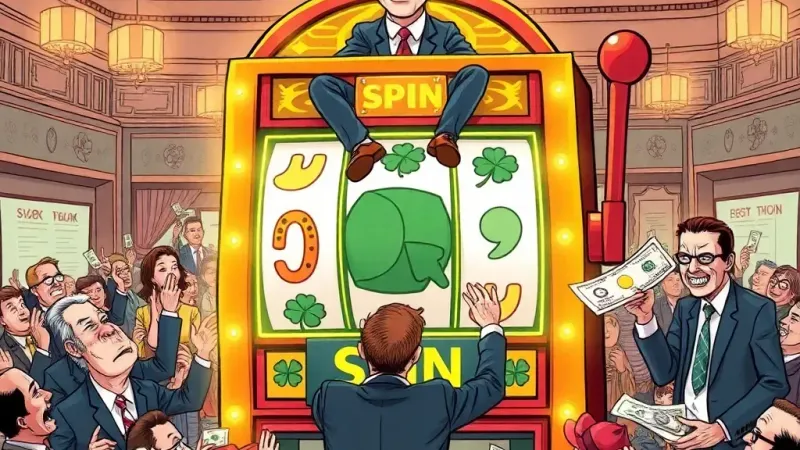
AUGUSTA, GA — The traditional statistical models and professional handicappers predicting the Masters winner have reportedly been sidelined this year by a powerful new market force: the collective, gut-level “feeling lucky” metric of the American betting public. This groundbreaking shift has seen long-established analytical methodologies replaced by a widespread, unquantifiable intuition, fundamentally altering how major sportsbooks are calculating odds for this week’s tournament.
While reigning champion and analytical darling Scottie Scheffler remains the bookmakers’ nominal favorite, his position is now significantly diluted by what market observers are calling “the Bryson Bump”—an overwhelming surge of public wagers on Bryson DeChambeau, seemingly driven by nothing more than a shared, pre-cognitive sense of impending fortune among casual bettors. This phenomenon has left data scientists at major gambling syndicates scrambling to incorporate the newly dominant “vibes-based algorithm” into their projections.
“We’ve got terabytes of historical data, advanced predictive analytics, neural networks trained on millions of swings, and then you’ve got Brenda from Boca Raton just *feeling* like it’s Bryson’s year,” explained Dr. Elias Vance, head of Quantum Betting Strategies at BetSure Inc., wiping sweat from his brow. “And right now, Brenda’s ‘gut’ is outweighing a full standard deviation of Strokes Gained data. It’s an epistemological crisis for predictive modeling.”
The market’s pivot has led to unprecedented shifts in media coverage, with major sports networks reportedly redirecting resources from deep-dive player statistics to conducting on-the-street interviews, asking everyday citizens who they “just have a feeling about.” One network is even rumored to be developing a “Hunch Heatmap” overlay for its broadcast, illustrating areas of the country experiencing peak levels of unadulterated, illogical optimism for various players.
Experts are cautioning that if this trend continues, the future of sports betting could transform into a pure popularity contest, where actual performance takes a backseat to compelling personal narratives and the sheer volume of optimistic amateur wagers. This development threatens to reclassify sports analysis from a rigorous 2 into a form of collective, wishful thinking. Many are concerned this could spill over into other markets, with economists now bracing for the inevitable “stock market driven by a good feeling about a CEO’s LinkedIn photo” era.
Sources confirm several major sportsbooks are already installing a new “Lucky Hat Index” for future major tournaments, weighted heavily towards whoever the public *really* wants to win, regardless of their current form or statistical probability.
Hambry is a satire publication. All articles are works of fiction.