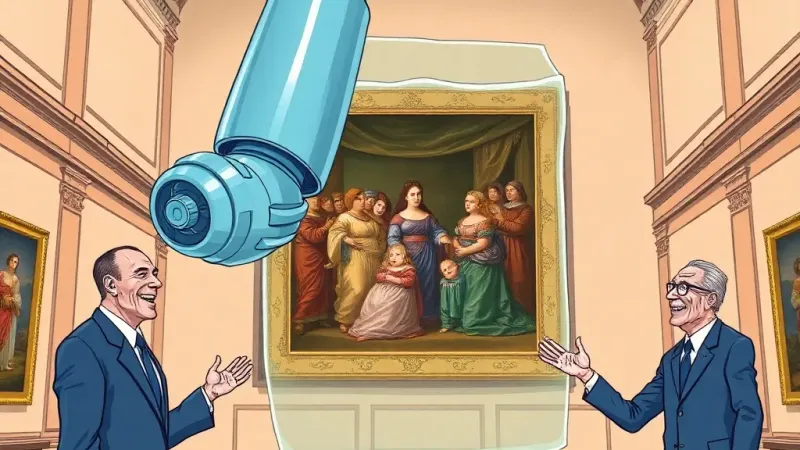
Madrid's venerable Prado Museum has quietly rolled out a state-of-the-art conservation initiative, deploying advanced chemical stabilization protocols and proprietary micro-environment enclosures designed to prevent its priceless collection from undergoing any further artistic or material evolution. The program, housed in a secluded, subterranean complex, ensures that works by masters like Goya and Velázquez will forever retain their current state, immune to the subtle shifts of age or even the occasional dust particle.
"For too long, we've allowed masterpieces to exist in a state of constant, gradual alteration," stated Dr. Elena Vargas, head of the Prado's Department of Chrono-Static Preservation, during a heavily restricted press briefing. "Every microscopic crack, every pigment shift, every instance of oxygen interacting with centuries-old varnish represented a deviation from... well, from *exactly how it looks right now*. Our mandate is to halt that. Permanently." Dr. Vargas detailed a process involving bespoke atmospheric controls and nano-level chemical inerting agents that effectively freeze paintings in their present moment, ensuring future generations will see precisely the same faint outline they did yesterday, and hopefully, for all eternity.
Among the breakthrough tools is the "Temporal Reification Chamber 7," a hermetically sealed unit that maintains environmental parameters within a +/- 0.0001% fluctuation, capable of preventing a single molecule of airborne moisture from ever contacting a canvas. Conservators now monitor pigment matrices with hyper-spectral imaging capable of detecting potential fade long before the human eye could even conceive of such a travesty. "Our most significant achievement last quarter," added chief conservator Miguel Soto, "was preventing a barely perceptible oxidation of a single brushstroke in Goya's 'The Family of Charles IV.' We caught it at the atomic level, averting what could have been a truly catastrophic re-interpretation of the monarchy's wardrobe." The museum's annual budget for this preventative "non-change" technology now rivals the GDP of several small nations, all dedicated to maintaining the aesthetic status quo.
While the new program ensures the immutable integrity of its collection, some critics have quietly raised concerns about the implicit message of art being "saved" from its own natural progression, or perhaps, from the very notion of time itself. Public tours of the restoration facilities are not currently offered, with museum officials citing the need for "uninterrupted stasis" in the precious conservation zones, which are also shielded from disruptive electromagnetic fields. "The public can rest assured that the art is here, safe, and unchanging," assured a Prado spokesperson who declined to be named due to "active non-disclosure agreements concerning all aspects of the Chrono-Static Initiative."
The museum anticipates that within five years, every major work will be so perfectly preserved, it will achieve a state of pure, unblemished archival permanence, indistinguishable from a high-resolution digital photograph.