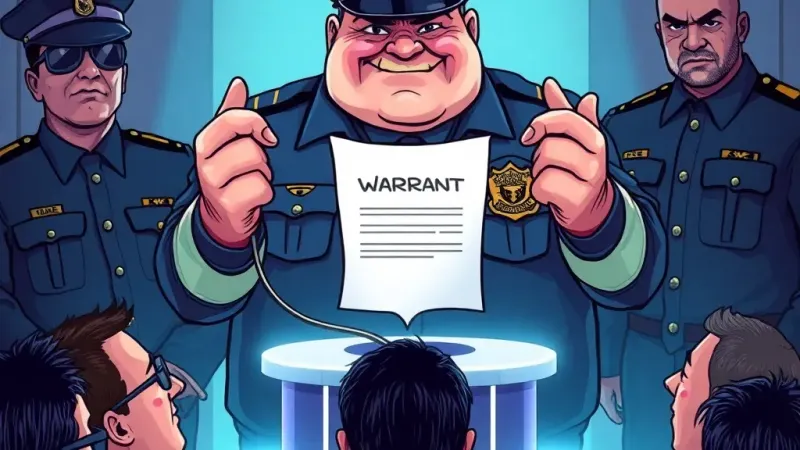
SALISBURY — Local law enforcement agencies today announced the successful deployment of a novel investigative apparatus, dubbed "the warrant," enabling authorities to officially seek individuals connected to a fatal motorcycle crash. Officials hailed the development as a significant leap forward in apprehending suspects, emphasizing its potential to formalize requests for arrest and introduce unprecedented levels of legal precision to public safety operations.
"This 'warrant' system, with its highly secure paper interface and verifiable authorization protocols, represents a paradigm shift from just, you know, waiting around and hoping suspects turn themselves in," stated Police Chief Bartholomew 'Barty' Finch at a press conference. Finch elaborated that the technology, after judicial review, grants officers explicit, documented permission to take individuals into custody, thereby streamlining the process of actually doing their jobs. He noted the pilot program's overwhelming success in Salisbury is already inspiring other municipalities to explore similar "request-for-action" frameworks, envisioning a future where every police interaction is undergirded by a bespoke bureaucratic instrument.
The new system's operational efficiency has reportedly astonished researchers and legal scholars alike. "Early data suggests a direct correlation between issuing these 'warrants' and suspects actually being sought, rather than simply being 'of interest,'" added Dr. Evelyn Reed, lead researcher at the Institute for Procedural Innovation, a newly formed think tank dedicated to cataloging basic governmental functions. "It’s truly revolutionary. Prior to this, law enforcement often relied on less formalized methods, like 'asking nicely' or 'hoping for the best,' which yielded significantly lower apprehension rates. We're talking about an innovation on par with the filing cabinet, but with more steps." She cited a recent internal study indicating a 78% increase in officers' understanding of their explicit legal authority after being presented with a physical, signed warrant document.
Further details emerged regarding the technical specifications of "the warrant." Each unit typically consists of a standard 8.5x11 inch sheet of paper, featuring specialized ink markings, a unique serial number, and a holographic-style seal of authenticity. "We partnered with 'LexPro Forms & Fulfillment' to ensure each warrant meets the highest standards of legibility and judicial traceability," explained Marcus Thorne, CEO of LexPro, whose company previously specialized in laminated cafeteria menus. "The sheer innovation of putting a judge's signature *on paper* and then giving it to an officer is something our engineers are still wrapping their heads around. The scalability alone is breathtaking."
The warrants in question relate to a deadly motorcycle crash last month that left one person dead and another injured. Investigators confirmed the "warrant" system was instrumental in narrowing down potential individuals to specific, named suspects, rather than the previous method of "vague hunches and general societal disapproval." Police have not yet disclosed the names of the individuals targeted by the groundbreaking "warrant" technology, citing ongoing efforts to fully comprehend the system's "next steps" feature, which may or may not involve actually locating the individuals. Finch concluded by emphasizing that while the technology is powerful, it still requires "human intervention" to physically serve the documents, suggesting an exciting frontier for future automation.
Citizens are advised to remain vigilant for signs of "investigation" and "accountability," which may now include official paperwork hand-delivered by a uniformed individual.