


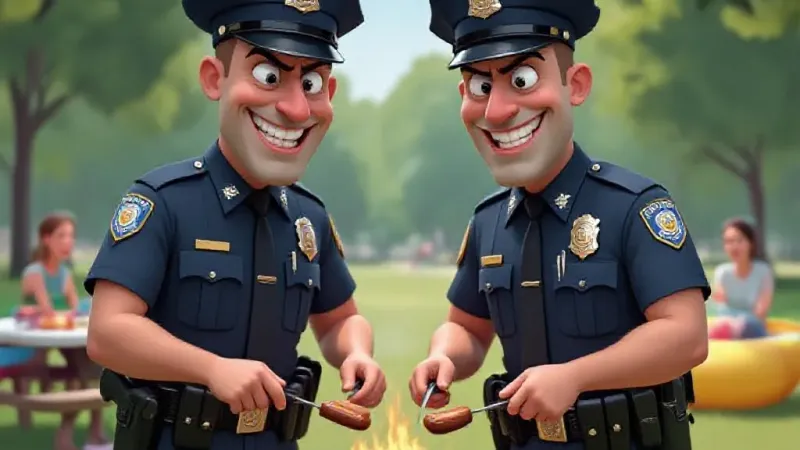
The annual "National Night Out," a federally mandated exercise in performative camaraderie, swept across the nation Tuesday, with police departments hosting block parties designed to remind citizens that, deep down, they're just like everyone else—only with qualified immunity and an AR-15 in the trunk. Over 230 communities in Pennsylvania alone rolled out the red (and blue) carpet, offering hot dogs, face painting, and the subtle, unspoken threat of state-sanctioned violence hanging over every interaction like a poorly inflated moon bounce.
"It's about humanizing the badge," explained Chief Brenda "The Hammer" Rodriguez of the Upper Darby PD, wiping mustard from her tactical vest. "When people see Officer Jenkins grilling a vegan burger, they forget about the time Officer Jenkins body-slammed a grandma for jaywalking. It resets the narrative." Department PR teams, often staffed by former TikTok influencers, were reportedly tracking "positive engagement metrics" throughout the evening, prioritizing photos where no citizen appeared visibly terrified by the sight of a police dog.
Community member LaToya Johnson, clutching a half-eaten cotton candy, admitted the event was "definitely a thing we do now." "It's like a forced family reunion where your cousin has a gun and a dash cam," Johnson said. "You show up, you smile, you nod, you pretend to enjoy the surprisingly bland potato salad. Mostly, you just want to make sure your kids don't accidentally ask about 'defunding' in front of the guy with the kevlar vest."
The evening's highlight for many departments was the "Touch-A-Cruiser" event, where children were encouraged to explore patrol vehicles, often fitted with intimidating anti-riot modifications. "It's crucial for kids to understand these aren't just vehicles for transporting suspects," a police spokesperson explained, "but also mobile command centers for community outreach, and occasionally, crowd control." As the sun set, officers were observed de-escalating a minor skirmish over who got the last mini-muffin, a vital training exercise for future larger-scale interventions.
By 9 PM, the last lukewarm burger had been consumed, the last uneasy handshake exchanged, and officers could finally shed their "friendly neighborhood cop" personas. The consensus among precincts was that the night had successfully generated enough goodwill to last until the next high-profile incident. Officials reiterated the importance of these annual events, noting that "it's far more cost-effective to throw a party than to address the root causes of community distrust." As the grills cooled, police across the state reportedly returned to their regular duties, which primarily involved not being at a picnic.