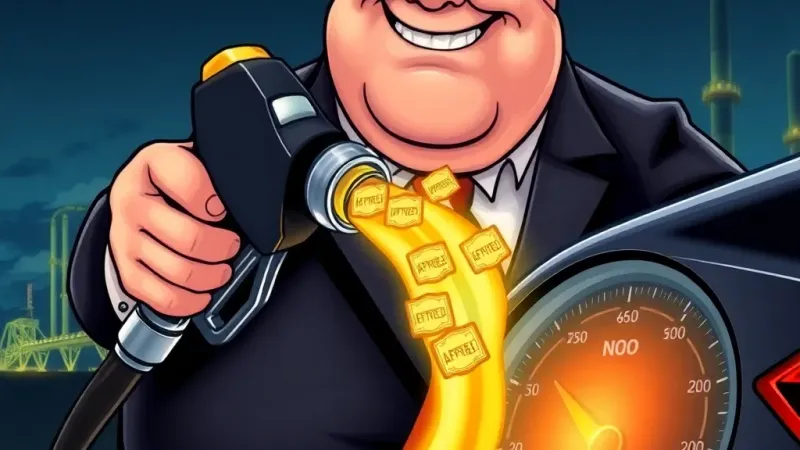
RIO DE JANEIRO – Brazilian state-owned oil behemoth Petrobras is set to vote on a groundbreaking new directive that would formally acknowledge and integrate “political stability” as a primary metric in its fuel pricing strategy, effectively codifying what analysts have long described as standard operating procedure. The proposed measure, expected to pass with overwhelming support, aims to provide greater transparency by aligning published corporate values with observable operational realities.
According to an internal briefing document reviewed by Hambry, the new framework will replace antiquated concepts like “global crude benchmarks” and “refining margins” with a dynamic “National Approval Rating Index (NARI)” and a “Pre-Election Comfort Factor (PECF).” Sources close to the board suggest the change will cut through bureaucratic red tape, allowing for immediate price adjustments based on the government's perceived popularity or upcoming electoral cycles. “Why pretend fuel prices are dictated by the global market when they're clearly dictated by quarterly approval ratings?” commented Dr. Sofia Vargas, head of Geo-Political Economics at the São Paulo School of Unofficial Policy. “This isn't a new policy, merely an extremely honest reclassification of existing practice. It’s like admitting the Emperor’s new clothes were never there to begin with, but then legislating that nakedness is now the official dress code.”
The shift is hailed by some as a bold step towards an integrated public-private governance model where the nation's energy supply functions directly as an instrument of national morale. “For too long, we’ve let the whims of international commodities markets dictate the sentiment of the Brazilian people,” stated Bruno Costa, a senior advisor to the Ministry of Strategic Resource Allocation. “With the new ‘Political Hedging Algorithm (PHA),’ we can proactively adjust pump prices to preemptively mitigate social unrest or enhance public appreciation for the current administration. It’s about energy security, yes, but more importantly, it’s about emotional security.”
Critics, primarily limited to a small, increasingly irrelevant cohort of free-market economists, argue that such explicit political entanglement could deter foreign investment and lead to financial instability. However, proponents quickly dismissed these concerns, pointing out that true stability is measured not in balance sheets, but in the peaceful slumber of a politically satisfied populace. One board member, speaking anonymously, was overheard remarking, “When you can calm the streets with a two-cent reduction at the pump, that’s better than any dividend.”
The move is expected to simplify future board meetings dramatically, allowing discussions to focus less on quarterly earnings reports and more on projected voter turnout in key swing states. Investors are advised to recalibrate their portfolios to reflect a new era where oil futures are directly correlated with gubernatorial approval ratings.
Petrobras maintains that the new policy will ensure fuel remains 'fair and accessible,' defined as 'just expensive enough to avoid accusations of reckless populism, but cheap enough to keep everyone from getting truly angry.'