
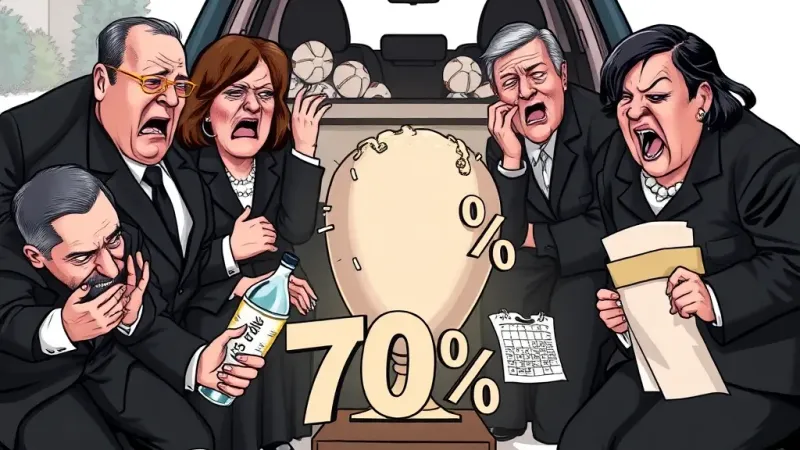
A recent analysis has delivered a crushing blow to parents nationwide, revealing that the long-treasured statistic claiming "70% of kids drop out of organized sports by age 13" is significantly overstated and largely misapplied. The news has left many scrambling for a new, easily digestible soundbite to explain away their emotional and financial investments in competitive youth athletics.
For years, the "70% dropout" figure served as a foundational pillar in parenting discussions, justifying everything from hyper-specialization and club travel teams to the lamentation of lost childhoods and the exorbitant cost of equipment. It provided a convenient, externally verifiable reason for why little Timmy didn't make the travel squad, or why Sarah quit soccer to focus on TikTok. Its accuracy, it turns out, was secondary to its utility as a communal societal grievance.
"The 70% stat was more than just a number; it was a cultural touchstone, a shared empathy point," explained Dr. Eleanor Vance, a socio-behavioral statistician at the Institute for Self-Serving Data. "It allowed parents to feel like victims of a system, rather than participants in one. It externalized the pressures, the burnout, the crushing reality of Sunday morning tournaments. Without it, they're left with... personal choices." Vance noted that while many kids *do* transition out of competitive leagues, the rate of complete disengagement from physical activity is much lower and far more nuanced, making it a far less satisfying narrative.
The void left by the debunked statistic is particularly acute for parents who built their entire identities around their children's sports careers. "I’ve spent thousands on equipment, driven countless miles, and alienated half my family trying to get my kid seen by scouts," lamented Brenda Higgins, a mother of three from Topeka. "Knowing that the 70% was a lie makes me feel like I invested in a pyramid scheme. What am I supposed to tell my boss when I need Friday off for a 'showcase' now? That my child just genuinely enjoys playing the 2?"
Youth sports organizations, long beneficiaries of the panic-inducing statistic, are reportedly scrambling to commission new studies. "We need something equally alarming, but perhaps slightly more accurate, to justify our 'player development' fees," stated Chet Williamson, CEO of Premier Youth Athletics, Inc. "Perhaps '85% of parents feel financially exploited by youth sports, but do nothing about it'? It lacks a certain punch, but it's closer to the truth."
Ultimately, the revelation leaves a stark and uncomfortable truth: without a convenient, universally accepted number to blame, parents may be forced to confront the actual, complex reasons behind youth sports engagement and attrition—reasons that often involve their own actions, expectations, and the simple reality that kids just want to have fun. The burden of genuine self-reflection falls heaviest on those who preferred a simple, tragic narrative.