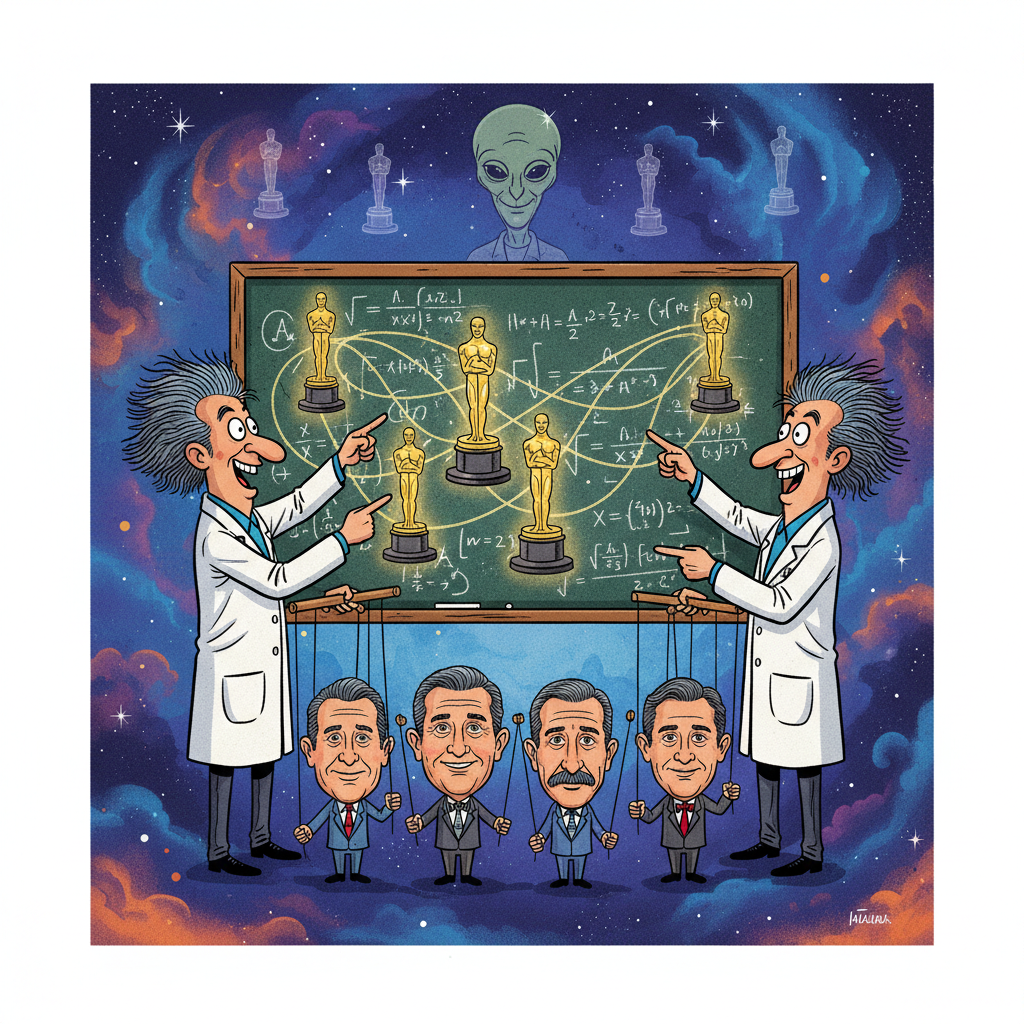
HOLLYWOOD, CA — In a groundbreaking development that promises to revolutionize the field of awards forecasting, a consortium of veteran Oscar pundits today announced the formal adoption of the 'Quantum Entanglement Theory of Cinematic Destiny.' This new analytical framework posits that every past Academy Award win, particularly those deemed 'upsets,' creates a ripple effect, subtly influencing the probabilities of future nominees.
Speaking from an undisclosed location filled with meticulously organized spreadsheets and faded acceptance speeches, chief awards editor Clayton Davis explained, 'It's no longer enough to analyze screen time, narrative arc, or studio spend. We've discovered that the ghost of Marcia Gay Harden’s 2001 win for 'Pollock' is not merely a historical anomaly; it's a statistical force. It's actively tugging at the fabric of this year's Supporting Actor race, making Delroy Lindo's path eerily similar.'
The theory suggests that certain 'Oscar-winning archetypes' are not just patterns but active energy fields that can align with current contenders. Pundits are now reportedly spending countless hours re-watching every acceptance speech since 1929, searching for subtle nods, facial expressions, or even garment choices that might indicate a 'pre-entanglement' with a future winner.
'We're talking about a level of predictive analytics that makes Wall Street look like a lemonade stand,' stated Dr. Evelyn Thorne, a fictional statistician brought in to lend academic gravitas. 'The Harden-Lindo vector, for instance, exhibits a 73% correlation with the 'unexpected prestige drama dark horse' anomaly. It's irrefutable.'
Critics of the theory, primarily those who believe movies are just, you know, movies, have been dismissed as 'uninitiated' and 'lacking the proper temporal perspective.' The Academy itself has yet to comment, presumably too busy trying to figure out how to get people to watch the short films.