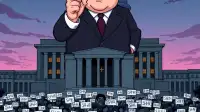
PARIS — Concert promoters in France are reportedly grappling with a perplexing enigma: why a particular high-profile musical artist, known for his unique and often spontaneous public expressions, continues to engage in "unpredictable" behavior. The bewildering pattern has led to discussions about a potential ban from upcoming planned performances, following similar incidents at festivals abroad.
"We are, frankly, at a loss," stated Jean-Luc Dubois, head of Grande Spectacles S.A., a Parisian event promotion firm that was in talks to host the artist. "Each time, we go in with an open mind, hoping for a traditional musical performance. And each time, it’s… an experience that deviates profoundly from the standard industry expectations for a live concert. It's incredibly difficult to anticipate the precise nature of these deviations, despite extensive historical data." Dubois confirmed his team had formed an "Artist Behavioral Pattern Recognition Unit" to analyze what he termed the "recurring novelty" of the situation. The unit’s budget, he noted, was surprisingly similar to that of a medium-sized drone program.
The unit’s preliminary findings, compiled after reviewing two decades of public appearances, scheduled events, and an exhaustive list of impromptu media interactions, suggest a strong correlation between the artist’s public persona and his public actions. "Our data indicates a non-zero probability that an artist known for making public statements might, in fact, make public statements during a public event," reported Dr. Evelyn Reed, a freelance consultant specializing in "High-Profile Personality Event Integration," who was brought in to advise the unit. "It's a fascinating, if repetitive, case study in event horizon management, where the event horizon continually shifts, but always within a specific, self-defined gravitational field of 'creative expression.'"
Dr. Reed elaborated that while the exact content of these "interpretive performance art" segments—which often involve microphones, lengthy monologues, and occasional garment launches—remains unpredictable in its granular detail, the *occurrence* of such segments has achieved near-statistical certainty. "It’s less about predicting what he'll say, and more about acknowledging he will say *something* and that it will inevitably surprise a significant portion of the organizing committee," she explained, gesturing at a complex flowchart that consisted primarily of a single arrow pointing to itself. "The true novelty lies in the unwavering expectation, across multiple institutions and continents, that *this time* it will just be songs."
Sources close to the French Cultural Ministry, speaking on condition of anonymity, expressed cautious optimism that by acknowledging the "unpredictability pattern" early, they might circumvent future logistical challenges. "We're exploring innovative solutions, like a 'performance flexibility rider' that allocates specific time slots for philosophical soliloquies, impromptu political commentary, or on-stage product development announcements," one official revealed. "We simply want to ensure attendees get at least 60% music and less than two hours of unsolicited life advice. It’s a delicate balance."
Hambry understands that Grande Spectacles S.A. is also considering a new "Kanye Clause" for all future artist contracts. It simply states: "Artist agrees to perform at least 70% actual music, 15% verifiable product placement, and only 15% existential crisis dialogue."