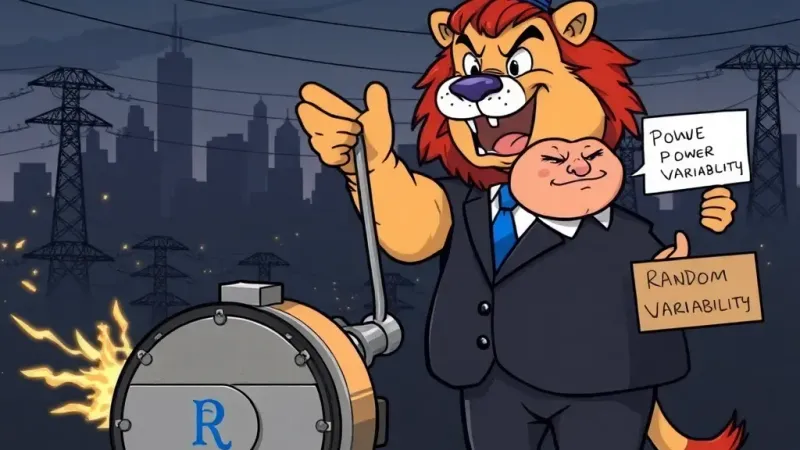
An alarming pattern of highly localized power grid failures has emerged across the Midwest, with multiple major blackouts reported in cities hosting the surging Kansas City Royals. These inexplicable outages have occurred precisely during critical moments of games where the Royals were poised to either secure a lead or extend an existing one, leading observers to speculate about what local news anchors are calling "an electrifyingly coincidental winning streak."
The unusual phenomenon first garnered national attention two weeks ago in Cleveland, when Progressive Field's entire surrounding neighborhood was abruptly plunged into darkness in the top of the seventh inning, mere seconds after a game-tying solo home run by Royals shortstop Bobby Witt Jr. Energy providers scrambled, eventually restoring power, but could not pinpoint a cause beyond "unforeseen atmospheric resistance." Similar incidents have since been meticulously cataloged. In Detroit, Comerica Park's crucial third-base camera system failed just as a game-winning double rolled into the gap. Chicago's Wrigleyville experienced a grid-wide flicker during a pivotal Royals rally, causing every electronic scoreboard to briefly display a static image of team mascot Sluggerr in a menacing pose. Most recently, Minneapolis reported a partial grid collapse that left Target Field’s digital ad boards frozen on a 6-2 Royals lead in the bottom of the eighth, forcing manual score updates.
"Look, I’ve been monitoring regional energy grids for forty years, through blizzards, heatwaves, and even that time a squirrel managed to short out a major substation near Gary," stated Dr. Aris Thorne, head of the North American Grid Stability Initiative, speaking from a dimly lit office. "But to have five distinct, geographically separate, and seemingly unrelated micro-failures—each impacting only a specific stadium’s immediate vicinity and happening exactly when the Royals are pulling ahead? That’s not a coincidence. That’s either a quantum entanglement event caused by peak athletic performance, or someone’s playing a very, very elaborate prank with a very expensive, highly localized electromagnetic pulse device. And honestly, the EMP device makes more sense given the timing." He declined to elaborate on which scenario he found more unsettling for the future of national infrastructure.
Major League 2 officials have vehemently dismissed any connection, citing "the random variability of aging urban infrastructure," "the inherent unpredictability of the American power grid under modern demands," and "the entirely legal application of competitive 2 strategies." However, sports talk radio across the affected regions has exploded with increasingly frantic theories ranging from advanced vibrational technology covertly embedded in Royals bats to a shadowy syndicate of deep-state utility workers who are just really, really big fans of a small-market team finally getting its due. Some online forums have even posited that the sheer, concentrated force of collective hope emanating from Kansas City’s fanbase is literally drawing so much ambient energy that it’s physically destabilizing local energy fields in opposing cities, creating localized energy vacuums around their ballparks.
Meanwhile, the Royals, who have now won nine straight games under what team management describes as "perfectly normal, well-lit circumstances," attribute their success solely to "good old-fashioned teamwork, exceptional scouting, and absolutely nothing that would ever show up on a thermal imaging scan of municipal power transformers or require federal investigations into grid sabotage."