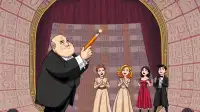
I was attempting to coax a wilting orchid back to life — a futile endeavor, much like attempting to inject vivacity into certain aspects of modern culture — when I received the news of the Metropolitan Opera's latest endeavors. They are, apparently, planning 'events leading up to' the premiere of an opera about Frida Kahlo and Diego Rivera, titled 'El Último Sueño de Frida y Diego.' One does wonder if the opera itself is insufficient, or if the modern attention span requires continuous preliminary fanfare.
But let us set aside the banality of 'pre-premiere events' for a moment and consider the profound, almost criminal, oversight the Met continues to make regarding the very nature of operatic experience. We speak of immersion, of transportation, of truly *living* the story, yet we content ourselves with merely *hearing* and *seeing*. This, I contend, is where the Metropolitan Opera, and indeed much of the contemporary art world, falters. To truly grasp the essence of an artist like Frida Kahlo, whose life was a tapestry woven with vibrant color, searing pain, and the intoxicating scent of creativity and mortality, one cannot simply sit in a plush velvet seat and passively observe.
Frida Kahlo's existence was a symphony for all five senses. Think of the acrid tang of turpentine mixed with the sweet, heady aroma of marigolds; the metallic taste of blood after yet another surgery, juxtaposed with the fiery kick of a mezcal shot; the coarse texture of indigenous fabrics against the smooth coolness of surgical steel; the constant ache in her spine, a physical reality that shaped her very perception of the world. How, I ask, can 'El Último Sueño' — a title that promises a journey into the very soul of a woman — hope to succeed if it neglects these fundamental sensory inputs? To merely show us her 'dream' is to present a shadow when we demand the substance.
These 'events leading up to' the premiere are, I fear, merely an intellectual appetizer when the audience truly hungers for a full, visceral feast. We need the subtle waft of burnt sugar and incense to evoke the Day of the Dead, a hint of jasmine or gardenia to place us in her garden, perhaps even a controlled burst of something resembling hospital antiseptic at a pivotal moment. Imagine the richness! And taste? A small, safe, individually wrapped, slightly bitter chocolate or a tiny, spiced wafer offered at the appropriate narrative beat – a symbolic morsel to represent life's sharp edges. And as for touch, why must our seats be so uniformly comfortable? A slight, controlled variation in texture, a gentle vibration, or even a momentary shift in ambient temperature could subtly mirror the instability and passion of her life without endangering the delicate sensibilities of the audience.
Of course, the timid will cry 'distraction!' 'Allergies!' 'Fire hazards!' To them, I say: Is the pursuit of genuine artistic engagement so easily dismissed by such trivial concerns? We are talking about connecting with genius, not a comfortable nap. True art demands that we step outside our pampered comfort zones, that we are challenged, not simply entertained. These are not 'gimmicks'; these are essential elements for true immersion, for opera to reclaim its place as a profound, transformative experience.
I therefore implore the Metropolitan Opera: for 'El Último Sueño de Frida y Diego,' and indeed for all future productions of significant thematic depth, abandon these anemic 'events.' Instead, embrace a full, unapologetic, multi-sensory assault on the audience. Let us not merely watch and hear, but taste, smell, and even feel the very essence of the story. Only then will opera truly awaken from its own long slumber.
One does hope they remember to turn the house lights back on eventually.