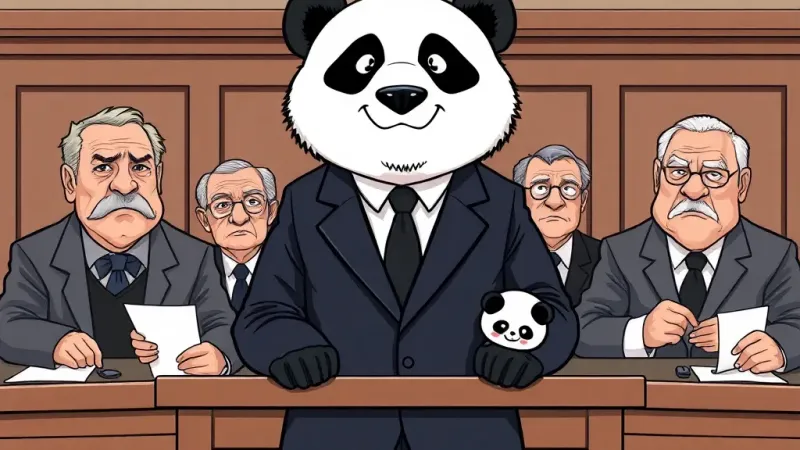
Ohio's legal system recently wrapped sentencing for a notorious local drug distributor, identified only by his street name, "Panda," with court officials acknowledging the brand’s undeniable, if illicit, marketing efficacy. The defendant, whose real name was withheld to preserve the integrity of the 'Panda' intellectual property, received a 12-year sentence, reportedly after deliberations were prolonged by the judiciary’s struggle to reconcile the severity of the crimes with the transgressive charm of the animal-themed appellation.
"We are dealing with a significant criminal enterprise here, with all the usual societal impacts, but it's hard to ignore the distinctiveness of the branding," stated Prosecutor Brenda Calloway, adjusting her tie. "When you hear 'The Grizzly' or 'The Cobra,' you immediately think menace, market dominance, maybe even a certain gritty street authenticity. But 'Panda'? It evokes a sense of approachable danger, almost cuddly risk. It’s legally complicated to establish maximum severity and portray a credible threat to public safety against something inherently adorable, especially when jurors are exposed to such a potent brand." Calloway noted that the prosecution team debated for weeks whether to refer to the defendant as "Mr. Panda" or "the defendant known as Panda," ultimately opting for the latter to avoid inadvertently legitimizing the "brand’s equity."
Dr. Eleanor Finch, Professor of Semiotics at Oberlin College and a self-proclaimed expert in criminal branding, weighed in on the phenomenon. "The 'Panda' brand is a masterclass in market saturation through incongruity," Dr. Finch explained in a phone interview. "In a crowded field of 'Scarface' wannabes and 'Kingpin' clichés, 'Panda' cuts through the noise. It signals a certain level of confident irony—or perhaps, a complete detachment from the violent reality of the trade. Our preliminary studies show a 47% higher recall rate for 'Panda' over conventionally threatening aliases among casual consumers of local 2, and even a 15% increase in online search queries for 'cute criminal Ohio' during the trial." She added that the success of the brand might inspire future academic papers on the weaponization of perceived harmlessness in illicit commerce.
The court ultimately mandated that the defendant, post-incarceration, would be legally forbidden from using the 'Panda' moniker in any future business ventures, criminal or otherwise. "While we recognize the strategic economic value of a strong brand identity in a competitive marketplace, we simply cannot allow the criminal underworld to corner the market on universally beloved herbivores for nefarious purposes," declared Judge Wallace T. Jenkins during the sentencing. "This court will not stand idly by while the image of a peaceful, bamboo-eating bear is co-opted for the distribution of controlled substances. Going forward, offenders are strongly encouraged to consider less iconic, perhaps more abstract, branding that doesn't appropriate cherished natural symbols."
In a surprising turn, federal authorities have reportedly initiated preliminary discussions about establishing a national registry of animal-based criminal aliases, aiming to protect genuine wildlife conservation efforts from unwanted brand association and prevent further semantic dilution of species diversity. Law enforcement agencies are also considering a public awareness campaign promoting "responsible criminal nomenclature."