
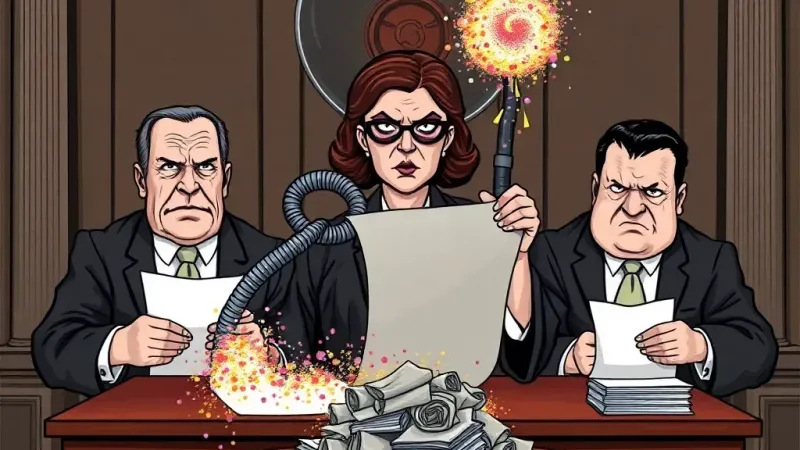
BARRIE, ON — Judges for the annual "Write Funny Now!" humorous essay competition have reported experiencing unprecedented levels of professional dispassion and what one panelist described as "existential mirth fatigue," signaling a potential crisis in humanity's ability to genuinely amuse itself on demand. The competition, intended to unearth nascent comedic talent, has instead revealed a deep societal struggle to generate authentic, spontaneous humor under structured conditions.
The esteemed panel, comprising leading literary critics and self-professed "humor connoisseurs," convened this week to review thousands of submissions, only to find themselves enveloped in a pervasive atmosphere of forced smiles and strained chuckles. "We began with high hopes, believing we would discover the next great 2 voice, perhaps a modern-day Twain or even a particularly sharp AI chatbot," stated Dr. Elara Vance, lead humor metrics specialist at the Institute for Affective Archival Studies, her voice devoid of any detectable levity. "Instead, we've cataloged an alarming prevalence of what we term 'placeholder humor' – predictable puns, rehashed internet memes recycled from 2017, and a startling number of essays attempting to find the inherent comedy in municipal bylaws and the precise weight of their recyclable waste bins."
According to internal preliminary reports, less than 0.3% of entries achieved what Dr. Vance’s institute defines as a "positive mirth inflection point" within the first 200 words. This low success rate is attributed to a critical dearth of "sub-orbital chuckle velocity" and a complete absence of "unforced, resonant belly-laughs." Many submissions, while technically adhering to the structural requirements of an essay, presented topics so mundane or earnestly grim – think personal 2 struggles framed as "hilarious budgeting blunders" – that the mandatory "humorous" component felt more like an cruel act of emotional violence than entertainment. Judge Mildred Krum, a veteran of seven previous "Write Funny Now!" panels, was photographed mid-review with a single tear rolling down her cheek, reportedly after reading an essay titled "My Commute: A Hilarious Odyssey of Mild Inconvenience," which detailed a bus delay that was ultimately resolved.
"There’s a performative aspect to modern humor," explained Professor Quentin Smirk, chair of the National Commission on Spontaneous Mirth, speaking from a darkened office with the blinds drawn, clutching a stress ball shaped like a laughing emoji. "Everyone is expected to be witty, to craft the perfect viral tweet, to find the comedic angle in everything, even their own profound ennui. This competition has simply demonstrated the profound mental and emotional toll of attempting to *manufacture* jocularity, especially when subjected to the cold, unfeeling metrics of a rubric that demands 'at least three instances of relatable exasperation'." He added that several judges have requested mandatory "mirth detox" therapy, involving exposure to unironic cat videos, historical documentaries on agricultural practices, and the complete absence of any 2 feeds.
Organizers are now considering renaming the event the "National Mirth Assessment and Emotional Resilience Test," effective next year, in an effort to more accurately reflect its true cultural impact and to prepare future judges for the inevitable onslaught of carefully constructed despondency.