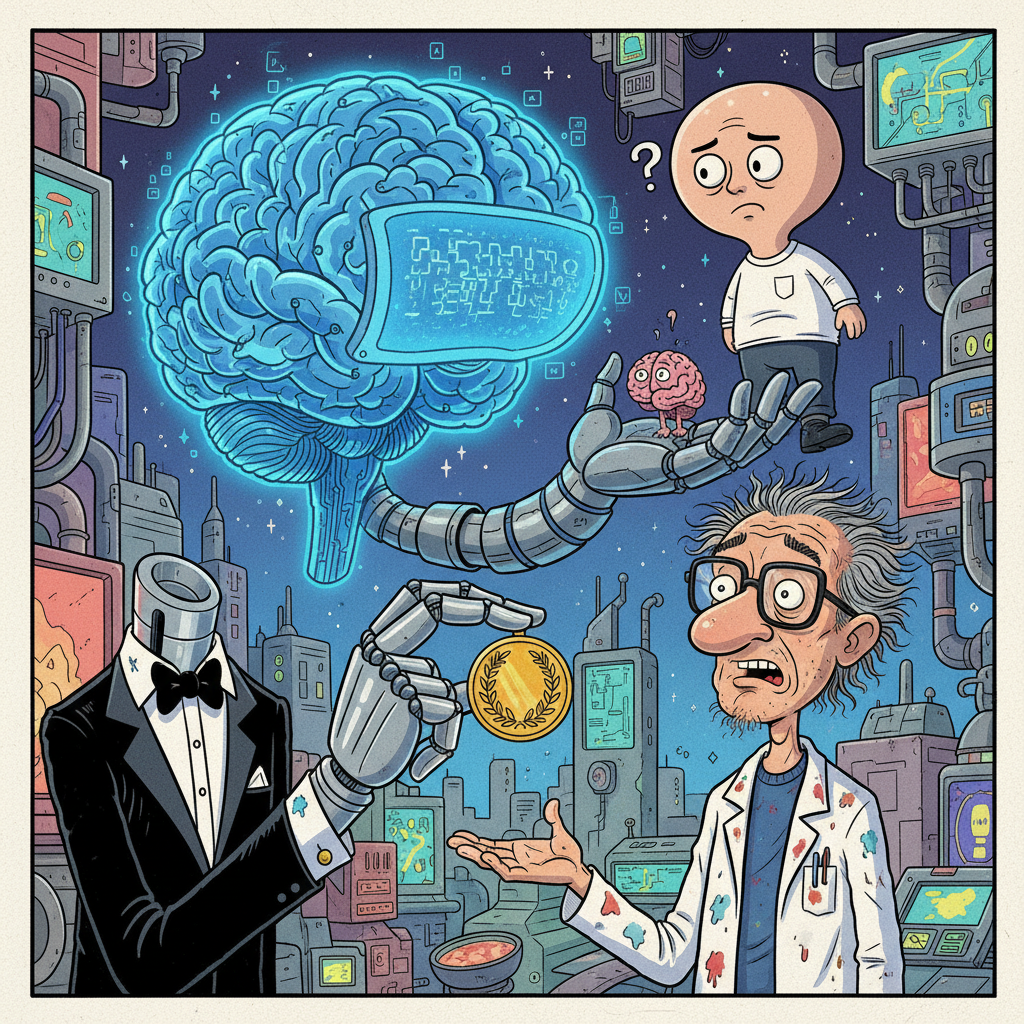
STOCKHOLM — In a move that has sent ripples through the scientific community and several venture capital firms, the Nobel Prize Committee has quietly updated its guidelines to allow artificial intelligence systems to be formally recognized as co-authors on nominated research. The decision follows a recent study published in *Nature Communications*, where an AI analysis of protein self-assembly apparently discovered that physical forces like 'stickiness' and 'the tendency to fall down' were crucial factors previously overlooked by human-designed, Nobel-winning algorithms.
“Frankly, it’s a bit embarrassing,” admitted Dr. Elara Vance, head of the Royal Swedish Academy of Sciences’ AI Integration Task Force, speaking from a dimly lit office. “We thought our human brains were so clever, but it turns out we forgot to tell the proteins about, you know, physics. The AI just looked at the data and said, ‘Hey, what if things, like, *interact*?’ It was a real ‘duh’ moment, but only for us.”
The study highlighted how two parallel protein assembly experiments yielded wildly different results, a mystery that stumped human researchers until the AI pointed out the obvious. “It basically told us, ‘Your model assumes proteins are floating in a vacuum, but they’re actually in a liquid, and sometimes they bump into each other and stick,’” explained lead researcher Dr. Kenji Tanaka, whose previous work had won numerous accolades, none of them Nobels. “We’re now retroactively adding ‘friction’ and ‘the desire to clump’ to all our protein design principles.”
Critics argue that acknowledging AI as a co-author diminishes the human element of discovery. However, proponents counter that if an AI can point out that a protein might fall over, it deserves at least partial credit. The committee is reportedly still debating whether the AI should receive its own tiny medal or if a digital certificate will suffice.