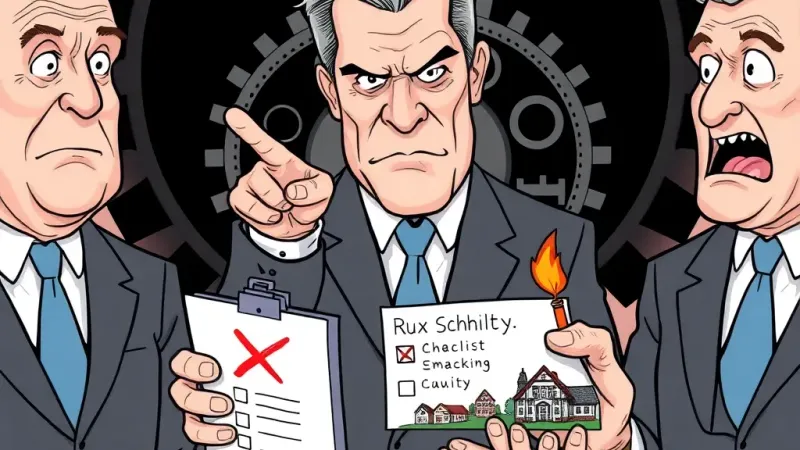
WASHINGTON D.C. — Communities across the Midwest are grappling with an unexpected bureaucratic challenge following a series of powerful tornadoes that caused widespread property damage but, remarkably, zero fatalities. Federal disaster relief agencies have reportedly paused several funding allocations, citing the lack of human casualties as a significant deviation from established aid activation protocols.
“Our current framework is designed to respond to critical human loss, which unfortunately creates a clear, quantifiable metric for immediate resource deployment,” explained Dr. Arlen Finch, a senior analyst with the Federal Emergency Response Office (FERO). “When you have a situation where dozens of homes are leveled, but everyone got to the basement in time, it really throws a wrench in the ‘severity assessment matrix’ we use to justify rapid, large-scale federal intervention.”
Sources within FERO, who requested anonymity to avoid being seen as insensitive, confirmed that the absence of a 'death count' makes it difficult to generate the necessary public and political will for expedited funding. “There’s no ‘face of the tragedy’ for cable news to feature,” one official noted dryly. “Without that, the damage just looks like… a really expensive property insurance claim. It doesn't trigger the 'national emergency' bypass codes.”
Local leaders in affected areas expressed frustration. “We’ve got entire neighborhoods flattened, small businesses completely destroyed, and people's livelihoods gone, but because nobody died, suddenly it’s not ‘catastrophic’ enough for the big checks,” said Mayor Brenda Kohl of Harmony Creek, Nebraska, where 80% of the town’s commercial district was obliterated. “Apparently, our resilience is now our biggest liability.”
Insurance adjusters are also reportedly navigating new territory, with one major underwriter, Federated Risk Solutions, admitting they are revising their actuarial tables. “Historically, significant property damage is often correlated with some degree of fatality, which helps us project claims complexity,” stated Federated spokesperson Marcus Thorne. “A scenario where thousands of structures are compromised, but human life is perfectly preserved, is, frankly, an outlier that requires a complete re-evaluation of our catastrophic event models. It’s an administrative nightmare.” The agency suggested that future tornado preparedness efforts might need to include a 'death impact simulation' to better prepare for funding scenarios.
While residents focus on rebuilding, federal agencies anticipate several weeks of internal policy debates before a new precedent for 'non-lethal, high-damage' natural disasters can be established, potentially delaying critical aid by months. The silver lining of human survival, it appears, is currently obscuring the gold standard for bureaucratic efficiency.