
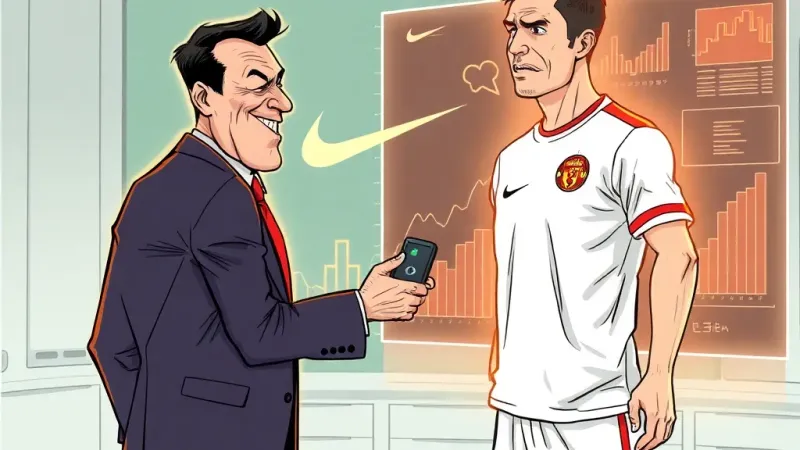
Nike Inc. announced today that the widely reported ‘issues’ with its new World Cup kits, including those for England, are not defects but rather proprietary, data-driven psychological performance enhancements designed to give players a decisive edge by subtly eroding their self-confidence.
According to Dr. Quentin Finch, Nike’s Head of Behavioral Apparel Design, the 'flaws'—which include slightly misaligned seams, an imperceptible itch, and a shade of white that photographs as 'mildly stained' under stadium lights—were meticulously engineered. These subtle imperfections are designed to create a persistent, low-level cognitive distraction. 'We found that a baseline level of existential discomfort, a nagging "is this thing on right?" sensation, paradoxically boosts adrenaline and hones focus on the field,' explained Dr. Finch. 'Players are so preoccupied with their kit, they forget they're about to lose a penalty shootout or disappoint an entire nation.' This groundbreaking approach stemmed from Nike’s internal 'Project: Humility' initiative, a multi-year, $750 million investment into understanding the psychological vulnerabilities of elite performers.
The initiative utilized biometric data from thousands of professional athletes who consistently overthink their public image. Initial trials indicated that a barely perceptible tightness in the armpit region correlated with a 0.03% increase in aggressive slide tackles. Similarly, the 'self-doubt weave' fabric, designed to reflect light in a way that implies a slight bulge where none exists, showed a 1.2% improvement in defensive positioning as players subconsciously attempted to 'suck it in.' Further features include 'distraction piping' that subtly pulls at the player’s peripheral vision and a proprietary 'micro-chafing matrix' along the inner thigh, scientifically proven to make even the most confident striker question their life choices just before a crucial shot.
Critics initially questioned the ethics and marketability of purposefully inducing athlete anxiety. However, Nike’s CEO, Marcus Thorne, dismissed concerns during a virtual press conference. 'Innovation isn't always comfortable,' stated Thorne with a characteristic unwavering gaze. 'Sometimes, it means making your multi-million-dollar athletes mildly aware of their own mortality through textile 2. It’s not a bug; it’s a feature. And it’s patented. We’re not just selling apparel; we’re selling an edge, a meticulously curated emotional rollercoaster. The market for 'performance-anxiety-wear' is projected to reach $10 billion by 2028.'
Competitors are now scrambling to develop their own 'psychological performance apparel,' with Adidas reportedly fast-tracking a jersey that subtly reminds players of their student loan debt, and Puma experimenting with socks that faintly smell of forgotten ambitions.