

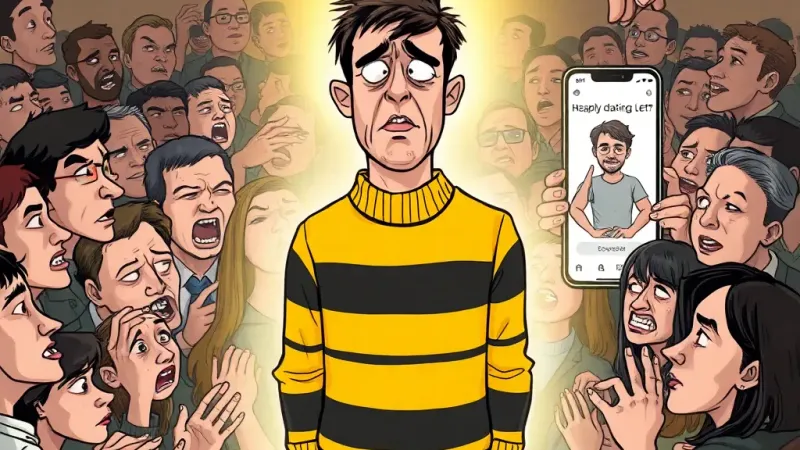
REGENSBURG, GERMANY – A groundbreaking international study has successfully identified the sex pheromone of the sandgrain-sized *Trichogramma* wasp, a discovery researchers are calling "unprecedented" for its elegant simplicity and immediate efficacy, especially when contrasted with humanity's increasingly convoluted methods of procreation. The research confirmed that male wasps are overwhelmingly attracted to females via an "unimaginably small" chemical signal, often requiring merely a few trillionths of a gram—an amount equivalent to a single forgotten text message from an ex—to trigger enthusiastic courtship behaviors and successful mating.
"We're talking about an organism so small you need a microscope to see it, yet its dating strategy is objectively superior to anything produced by Silicon Valley's finest algorithms," stated Dr. Lenora Vance, lead entomologist at the University of Wageningen, struggling to keep a straight face during a press conference. "No swiping, no curated profiles, no exhausting conversational gymnastics. Just a perfectly engineered molecular whisper saying, 'I'm here and I'm hormonally ready,' and boom—instant, undeniable connection. Frankly, it's a profoundly humbling, if not outright embarrassing, revelation for us advanced primates." She added that preliminary data suggests zero instances of 'ghosting' or 'breadcrumbing' among *Trichogramma* populations.
The study, published in *Science & Nature: Tiny Horny Bugs Edition*, detailed how the miniscule females emit a blend of specific hydrocarbons that act as an irresistible beacon for males up to several millimeters away, a distance equivalent to a human traveling across a small city for a first date that actually leads somewhere. This sophisticated chemical communication allows the wasps to efficiently reproduce, maintaining their critical role as natural pest antagonists in agricultural landscapes—a societal contribution that largely goes unnoticed by humans busy optimizing their digital 'super likes' for optimal engagement and minimal emotional expenditure.
Scientists confirmed that even after weeks of repeated exposure to the pheromone, *Trichogramma* males showed no signs of "situationship ambiguity" or sudden, unexplained disinterest. "There's an undeniable, almost brutal purity to it," added Dr. Alistair Finch, a behavioral ecologist from the University of Groningen, who admitted to feeling a profound sense of existential dread while observing the wasps' uncomplicated reproductive drive. "They just want to find each other, get the job done, and continue the species. There are no mixed signals, no attachment issues, and certainly no debates about who pays for dinner. It makes you wonder what all the extra human brain cells, and billions of dollars in dating app R&D, are actually *for*."
Funding for a new cross-species dating app, 'WaspMate,' which promises to distill human attraction down to a singular, non-negotiable chemical signature, has reportedly been secured from a venture capital firm specializing in "efficiency-disrupting romance."