
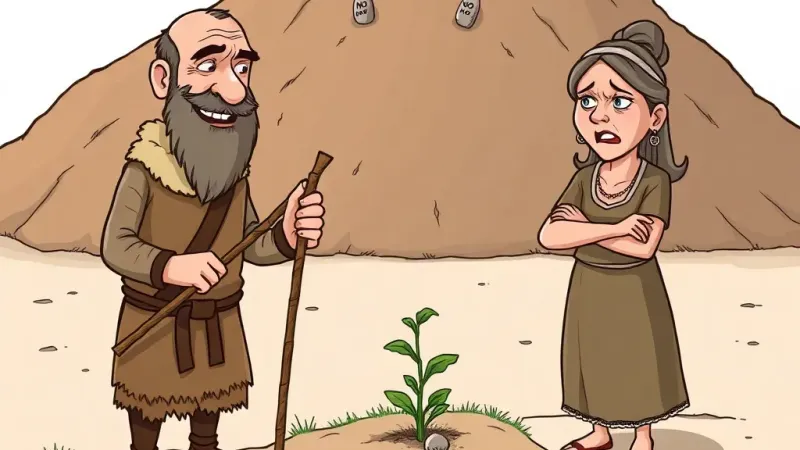
NES, NORWAY – For centuries, historians believed Raknehaugen, Scandinavia's largest prehistoric mound, was the final resting place of a powerful king. New LiDAR analysis, however, published in the *European Journal of Archaeology of Inconvenient Truths*, suggests the monumental structure was actually a gargantuan, passive-aggressive attempt to resolve a property dispute that escalated far beyond what any reasonable person would consider proportionate.
Dr. Lena Bjork, lead researcher at the University of Oslo’s Institute for Petty Grievances in Antiquity, stated, “Our data indicates subtle erosion patterns consistent with centuries of passive-aggressive staring contests over a shared irrigation ditch. It appears the entire community eventually rallied to bury the evidence of their collective inability to use a protractor and negotiate like adults.” Bjork’s team uncovered clear geological signatures of what appears to be a strategically induced ‘minor landslide’ on one neighbor’s property, followed by the rapid construction of an enormous dirt pile to cover both the perceived affront and the ensuing mudslide. “We found ancient clay tablets that, when translated, essentially read: ‘We asked him nicely, then we asked him less nicely, then things got… muddy. So we covered it with a hill. Problem solved,’” Bjork elaborated, offering unprecedented insight into prehistoric conflict resolution.
The findings challenge generations of scholars who dedicated their careers to the romanticized narrative of royal burial rites and centralized power. Instead of reflecting a king's vast influence over his subjects, Raknehaugen now appears to represent the prehistoric equivalent of a community deciding to erect a 60-foot tall fence around a neighbor who refused to trim their hedges or, perhaps, who kept leaving their ancient longboat parked across the communal path. "This reframes the entire field of megalithic studies," added Dr. Bjork, "from 'ancient power projection' to 'advanced conflict resolution via extreme resource allocation and total neighbor annihilation.' It turns out the 'king' buried here might simply have been the unfortunate recipient of a historically significant HOA cease-and-desist letter."
The revelation has sent shockwaves through the archaeological community, forcing many to re-evaluate what other grand historical monuments might actually represent. "Are the Egyptian pyramids just elaborate sandboxes for bored pharaohs?" pondered Dr. Elara Vance, an independent historian, speaking from her home office littered with discarded theories. "Is Stonehenge actually a complicated sundial for tracking laundry drying times?"
Local tourism officials, who have long marketed Raknehaugen as "The Last Great Sleep of the Northern Kings," are reportedly scrambling to update brochures. Initial proposals include "Raknehaugen: Proof Ancient People Were Just As Annoyed By Their Neighbors As You Are" or "Come See The World's Oldest 'Keep Off My Lawn' Sign." The municipality is also considering a new gift shop line featuring miniature mounds inscribed with phrases like "My Ancestors Built This To Shut Up Carl."
Further analysis is underway to determine if the adjacent, smaller mounds are actually ancient 'sorry, not sorry' gifts, or simply discarded materials from the initial landscaping project, possibly covering ancient lawn gnomes.