
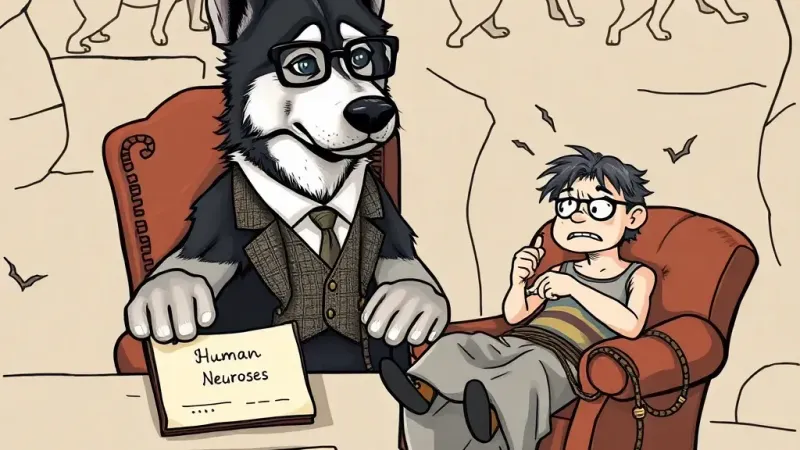
PALEO-CANINE RESEARCH INSTITUTE, ANCIENT SIBERIA — A multi-decade study released today has definitively pushed back the timeline of human-dog co-habitation, revealing that what was previously thought to be 'mutual partnership' was, in fact, an extended, multi-millennial exercise in canine patience and strategic emotional labor. Researchers now estimate dogs have been subtly tolerating humanity for at least 33,000 years, significantly longer than previously believed.
The findings, published in the journal *Archaeo-Canis*, suggest that from the earliest interactions, canids adopted a role of benevolent, albeit frequently exasperated, overseers of their bipedal counterparts. Dr. Elara Vance, lead archaeozoologist at the Paleo-Canine Research Institute, stated, “We’ve analyzed fossilized droppings, tool marks, and even ancient scent trails, and the overwhelming evidence points to dogs consistently being the more emotionally mature party in the relationship. They were essentially managing humans’ 2 long before we had language for it.”
The study highlights periods where canine endurance was particularly stretched, such as the Upper Paleolithic era, characterized by what researchers describe as 'uninterrupted human grunting sessions' and 'ineffective hunting strategies requiring canine intervention.' Early dog breeds, like the now-extinct Proto-Schnauzer, were apparently bred for their extraordinary capacity to maintain a neutral facial expression while witnessing primitive humans attempt to invent the wheel for the fifth time. “The sheer volume of deep, resigned sighs we’ve detected in ancient dog vocalizations is staggering,” Dr. Vance added.
Modern canine behaviorists are not surprised. “It’s simply an extension of what we see today,” explained Dr. Milo Higgins, a behavioral psychologist specializing in interspecies dynamics. “Dogs have always been adept at masking their true feelings, often with a well-timed head tilt or a bark that sounds enthusiastic but actually translates to ‘Oh, *this* again?’ Their ability to pretend that throwing a stick is the most fascinating event of the day, even after the 300th repetition, is a testament to their unwavering commitment to the bit.”
The study concludes by suggesting that every time a human has ever looked lovingly into their dog's eyes, the dog was most likely evaluating their owner's life choices and silently considering the optimal time for a bathroom break.