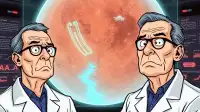
PASADENA, CA — Groundbreaking research from the California Institute of Planetary Indifference has confirmed what many astronomers have long suspected: Venus, the solar system’s most notoriously sluggish rotator, actively devoured its own moon. Computer simulations revealed that unlike Earth’s moon, which gracefully drifts away, Venus's satellite was doomed to an agonizing, inward spiral, plunging directly into the planet’s molten core. Scientists attribute the moon’s demise to Venus’s profound, unyielding apathy, manifesting as an agonizingly slow rotation that generated an irresistible, self-cannibalizing gravitational vortex.
"It wasn't a sudden, cataclysmic event, but a slow, inevitable process born of pure, unadulterated planetary inertia," explained Dr. Kaelen Thorne, lead author of the study and director of the Institute for Celestial Self-Destruction Studies. "Imagine being so fundamentally inert, so stubbornly slow-moving, that anything orbiting you, anything sustaining your reflected light, simply gets sucked in and consumed. It's less a gravitational pull and more a gravitational *shrug* that says, 'Eh, come on in. Whatever.' The simulations showed larger moons were consumed even faster, suggesting Venus prioritizes the swift removal of anything substantial that dares to approach its orbit and demand even minimal rotational effort." Thorne paused, adjusting his glasses. "The bigger the contribution, the faster it was sacrificed on the altar of Venusian lassitude."
The study, published in the journal *Planetary Sociopathy*, models a celestial body so utterly committed to its own glacial pace that it actively dismantles its support structures, then acts surprised when it’s left alone in the dark. "It’s a clear case of planetary self-sabotage, an existential 'my way or the highway' for gravitational fields," added co-author Dr. Lena Hsu, pointing to data indicating that Venus's rotation is so slow, its "day" is longer than its "year." "The moon literally couldn't escape the gravitational eddy created by Venus's sheer unwillingness to pick up the pace. It just sort of... got tired and fell in. We even found evidence of a brief period where the moon attempted to 'pivot to video' to gain Venus's attention, but the planet simply continued its slow, indifferent grind."
A simulated "Venusian consciousness" developed by the research team showed consistent internal monologue fragments during the moon's final descent, including phrases like "Is this really happening?" and "Maybe if I just ignore it, it'll go away." The consciousness also expressed a deep, almost spiritual commitment to not changing its rotation for anyone. "We've seen this behavior before," noted Dr. Thorne. "Usually it's from C-suite executives announcing another 'restructuring' after gutting their entire middle management, or politicians wondering why nobody wants to 'work' anymore after defunding every social safety net. The results are remarkably similar: a slow, internal collapse masquerading as natural cosmic law."
The good news? Earth’s moon continues its stately outward drift, proving that sometimes, just sometimes, not being Venus is enough. Though with recent market trends, Dr. Thorne admits he's "keeping an eye on Luna just in case."