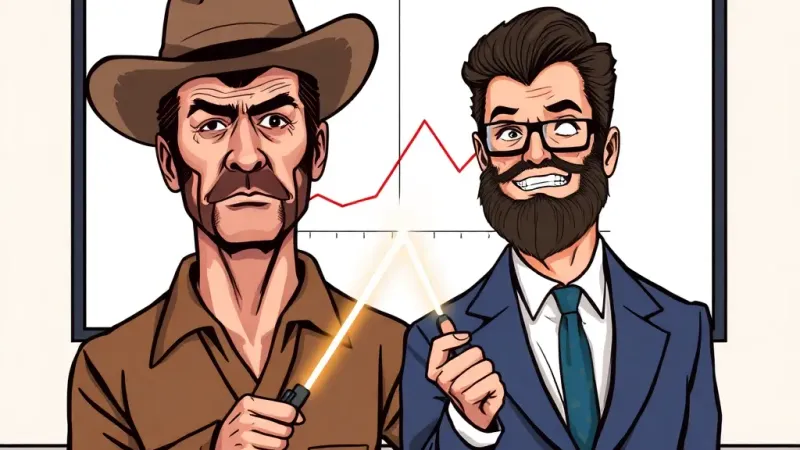
A landmark academic study published today by the Institute for Cinematic Parity (ICP) has definitively concluded that the filmographies of action legend Chuck Norris and Western icon John Wayne are, to the average viewer, effectively indistinguishable. Researchers, employing a battery of advanced analytical techniques including proprietary narrative algorithms and biometric audience feedback, found that a significant majority of survey participants could not consistently identify which actor's work they were watching when presented with randomized, decontextualized clips stripped of identifying credits or iconic theme music.
The study, titled "The Wayne-Norris Continuum: A Quantitative Analysis of Cinematic Impact and Audience Perception," involved over 10,000 subjects and meticulously cataloged everything from punch-to-dialogue ratios to the number of times a protagonist wore a hat. "Our data suggests a profound overlap in viewer engagement across a range of emotional and physiological markers," stated Dr. Elara Vance, lead researcher and Chair of Comparative Action Studies at the University of West Dakota. "Whether it was a roundhouse kick deflecting a bullet or a steely gaze commanding respect, the emotional resonance, as measured by galvanic skin response and pupil dilation, was remarkably consistent across both canons. The perceived gap, it seems, was largely a figment of historical revisionism, fueled by marketing and the unfortunate absence of synchronized martial arts in 1950s Westerns."
Critics of the study, who argued that thematic depth, directorial vision, and intricate historical context were being recklessly overlooked in favor of superficial metrics, were summarily dismissed by ICP's Director of Public Outreach, Bartholomew 'Barty' Finch. "Frankly, those are just academic excuses for not enjoying a straightforward narrative," Finch stated in a press conference that featured a surprisingly high number of karate chops. "We measured the fundamental components: a gruff man, a clear objective, and the systematic dismantling of obstacles, often with a significant body count and a vaguely defined sense of patriotic duty. The only variable that consistently differed was the optimal viewing distance required to fully appreciate the protagonist's facial hair. For Norris, it was closer to gauge the intensity of the beard. For Wayne, you needed to lean back more to get the full breadth of the handlebar."
The ICP team now plans a controversial follow-up study to determine if the perceived quality of a Chuck Norris film increases exponentially with the prior consumption of cheap domestic lager, a variable they admit was regrettably unmeasured in the initial phase despite anecdotal evidence suggesting a strong correlation. "It's about the feeling, not the film's IMDB score," added Dr. Vance, adjusting her own Stetson. "And both Norris and Wayne reliably deliver a very specific feeling. A feeling of impending justice, preferably delivered with a single, decisive blow, whether that's a fist or a rhetorical put-down, culminating in a satisfying, if predictable, resolution."
The findings are expected to force film schools nationwide to immediately combine their "John Wayne: American Icon" and "Chuck Norris: Unstoppable Force" seminars into a single, comprehensive "Grumpy Men Who Get Things Done" module, likely taught by a single, grizzled professor with a penchant for denim.