
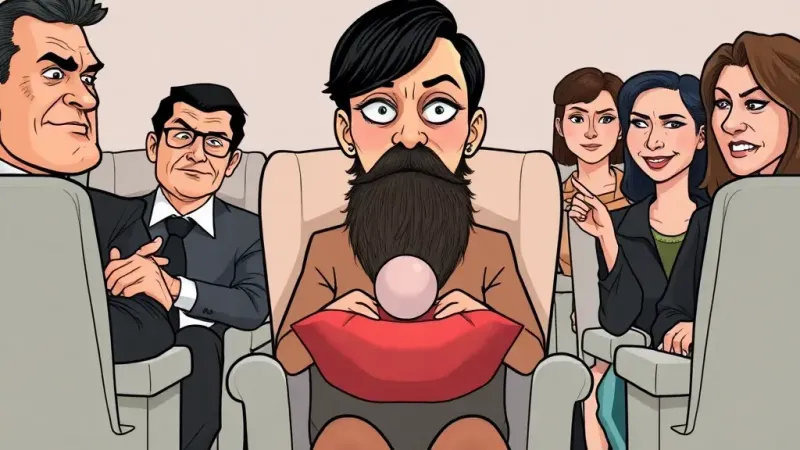
CHICAGO – What began as a safe space for individuals grappling with specific phobias has apparently morphed into a subtle, yet fierce, competition to claim the most unique and debilitating fear. New data from the National Institute of Cognitive Quirks (NICK) indicates that meetings, originally designed for anonymous sharing and mutual aid, now frequently feature participants attempting to one-up each other with increasingly niche and improbable anxieties.
"Initially, we had a lot of 'arachnophobes' and 'claustrophobes' – the classics," explained Dr. Elara Vance, lead researcher at NICK and a self-diagnosed 'anemopsychrophobe' (fear of cold wind on the soul). "But now, sessions are often dominated by individuals presenting conditions like 'papyrophobia-digitalis' – the acute terror of touching printer paper after using a touchscreen device – or 'chimeraphobia-ludica,' a crippling dread of NPCs in open-world video games achieving sentience and judging your life choices." Dr. Vance noted a significant uptick in self-diagnosed phobias that conveniently align with current online 2 or 2 choices.
Attendance at groups for these hyper-specific phobias has surged by 38% in the past quarter, particularly among the 18-35 demographic. Experts suggest this trend reflects a broader societal inclination towards hyper-specialized identity construction. “It’s less about overcoming the fear and more about owning it, brandishing it even,” noted Marcus Thistlewaite, founder of Phobia-Agnostic, an online platform dedicated to connecting individuals with fears so specific they defy classification. “You get more engagement on TikTok if you have 'sidonglobophobia' (fear of cotton balls sticking to your socks) than if you just dislike spiders.”
One attendee, who wished to remain anonymous but identified as suffering from 'chromascarphobia' (the inexplicable fear of wearing brightly colored scarves on a Tuesday), described the evolving atmosphere. "Last week, someone tried to present 'omniphobia-non-specific,' the fear of absolutely everything, as a valid entry. We had to explain that while certainly pervasive, it lacked the granular detail necessary to truly resonate with the group's highly refined sensibilities. It felt a little like cheating, honestly, trying to win with quantity over quality.”
Organizers are now considering implementing a formal 'Phobia Review Board' to vet newly declared anxieties, ensuring they meet minimum criteria for specificity, originality, and potential for compelling anecdotal sharing, thereby preserving the competitive integrity of the support spaces.
The real irony, many observers note, is that these increasingly specialized fears often prove less debilitating than the general anxiety of being perceived as uninteresting or unremarkable by one's peers.