
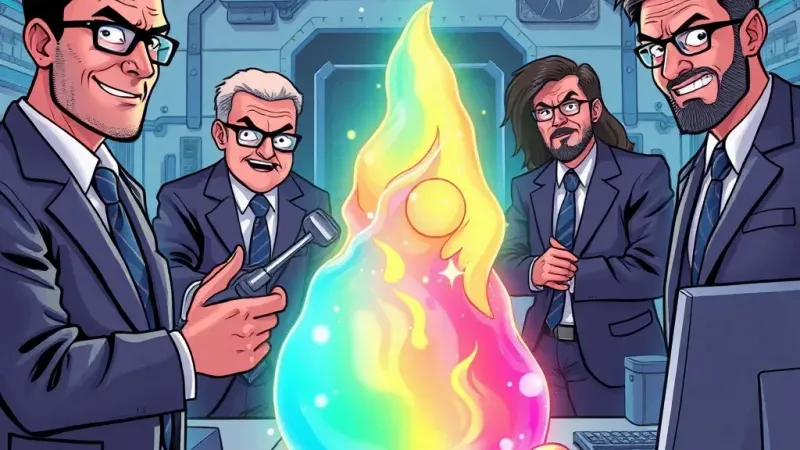
TOKYO — In a move widely anticipated by industry analysts, the development team behind the 'Blue Reflection' franchise has confirmed their entire intellectual property was strategically designed to appeal to a highly specific, rapidly growing market segment: players who "want something 2." This isn't accidental artistry; it's a meticulously crafted, algorithm-driven approach to interactive media.
"Our internal analytics identified a significant, underserved demographic craving experiences that actively resist conventional narrative structure, logical character motivation, and predictable gameplay loops," stated Kaito Ishikawa, Lead Narrative Architect for the series, speaking from a meticulously curated "chaos room" at Koei Tecmo. "We didn't just stumble into 'weirdness'; we engineered it. Every design choice, from the non-sequitur dialogue trees to the deliberate inclusion of lore inconsistencies, is calibrated to generate a specific 'perplexion unit per hour' score, ensuring optimal befuddlement for our target audience." Ishikawa elaborated on the proprietary "Schrödinger's Gameplay Engine," which purportedly allows for multiple, equally illogical plot resolutions to exist simultaneously until a player's irrational choice collapses the wave function into a singular, bizarre outcome.
The strategy, dubbed "Weirdness-First Design" (WFD), has garnered significant attention across the gaming landscape. Industry reports indicate a noticeable uptick in studios prioritizing unconventionality over traditional metrics like critical acclaim or coherent storytelling. "It’s a brilliant pivot," explained Dr. Evelyn Reed, a Senior Market Analyst at Digital 2 Forecasting Inc., whose firm tracks emerging gamer psychology. "In a saturated market, you can't just be 'good' anymore. You need to be *different*. And 'different' often translates directly into 'weird.' These are the players who've seen everything, played everything, and now just want a game that makes them question reality, or at least wonder if the developers forgot to include a crucial cutscene." Dr. Reed pointed to the rising popularity of titles where the most celebrated moments are often user-generated compilations of glitches or unexplained phenomena.
The 'Blue Reflection' series has reportedly become a case study in WFD, with its intricate systems of magical girl angst, high school drama, and inexplicable cosmic threats coalescing into a product designed for maximum narrative dissonance. "We've found that delivering a sense of 'What just happened?' is far more memorable than delivering 'That was a satisfying conclusion,'" Ishikawa added, gesturing to a whiteboard filled with flowcharts titled "Non-Euclidean Story Progression" and "The Joy of Unanswered Questions." The team is already working on 'Blue Reflection: Untangled Realities,' which promises to eliminate all discernible plot points in favor of pure, unadulterated aesthetic confusion.
With the success of this specialized approach, gaming executives are now reportedly exploring other niche algorithms, including "Actively Annoying Sound Design Optimization" and "Procedurally Generated 2."