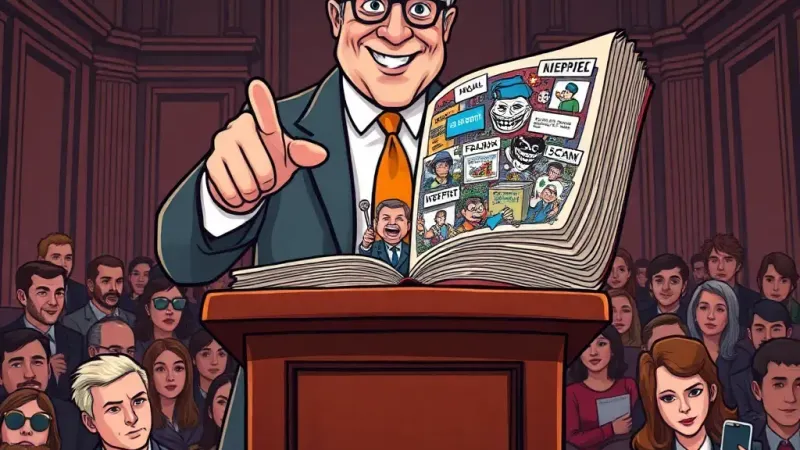
A groundbreaking new book by acclaimed tech critic Cory Doctorow is set to confirm what billions of users have long suspected: the internet, far from a vibrant ecosystem of connection and innovation, is still quite bad. Titled *THE POST AMERICAN INTERNET*, the forthcoming work promises exhaustive evidence that the digital landscape remains mired in predictable dysfunction, 2 malfeasance, and the persistent erosion of user experience.
The highly anticipated publication, set for release next year, draws upon decades of online behavior and the collective sigh of a global population to present its core thesis. "It's a monumental achievement in stating the obvious so eloquently it almost feels revelatory," noted Dr. Evelyn Reed, a professor of Digital Media Studies at the University of West Tacoma, speaking about an advance synopsis. "Doctorow meticulously lays out how platforms decay, data privacy evaporates, and user control vanishes, all while everyone involved pretends this is normal, inevitable, or an exciting new 'paradigm shift.' The elephant in the room has always been that it's just a shittier version of what we had, but now it's got a hardcover and an audiobook narrated by a chipper AI."
Sources close to the project suggest the book includes meticulously footnoted chapters on "The Algorithmic Ennui of the Scrolling Infinite," "Monetizing Your 2, Version 3.1: Now With More Microtransactions," and "The Surprising Persistence of the Pop-Up Ad That Somehow Dodged All Your Ad Blockers." Early reviews praise its unflinching commitment to detailing phenomena such as the 17% increase in user frustration between 2020 and 2024, or the average 2.3 seconds users spend questioning their life choices after encountering an unskippable ad for an AI-powered smoothie maker. Major tech publications are already preparing "deep-dive analyses" and "exclusive interviews" to discuss the book's "bold" and "unsettling" findings, many of which will be hosted on platforms actively contributing to the very issues being critiqued, complete with sponsored content.
Industry analysts predict the book will become an essential read for anyone seeking formal, peer-reviewed validation for their daily online misery, transforming vague gripes into actionable despair. "This book isn't just a critique; it's a therapeutic affirmation for the digitally exhausted," explained market strategist Liam Chen of Global Foresight Group. "For years, people have just been instinctively closing tabs, deleting apps, and muting notifications, operating on a hunch that things were deeply flawed. Now, they'll have 400 pages of scholarly argumentation explaining exactly why their digital life feels like trying to navigate a sewer system designed by toddlers for profit. It's truly a watershed moment for legitimizing widespread, low-grade annoyance and providing concrete data points, like the fact that 83% of users report mild nausea when confronted with another 'viral' dance challenge."
The book further delves into the titular "Post American Internet," positing that the utopian ideals of early Silicon Valley have been replaced by a fragmented, commercially cannibalized landscape dominated by opaque algorithms and geopolitical power plays. "We're not just talking about ad tracking; we're talking about the fundamental architectural decay of the digital commons, repackaged as 'Web 4.0 innovations'," stated Dr. Aris Thorne, a visiting fellow at the Institute for Futility Studies. "It's a landscape where every click is a commodity and every human interaction a data point for a system that actively undermines its own utility for profit. The 'American' part, with its quaint notions of free speech and open access, is now mostly a branding exercise."
Doctorow's next project, *NO, YOU’RE NOT IMAGINING IT: THE SHOCKING TRUTH ABOUT WHY YOUR FOOD TASTES LIKE CARDBOARD AND YOUR AIRLINE SEAT IS SHRINKING*, is already in the pipeline, promising equally devastatingly obvious revelations.