
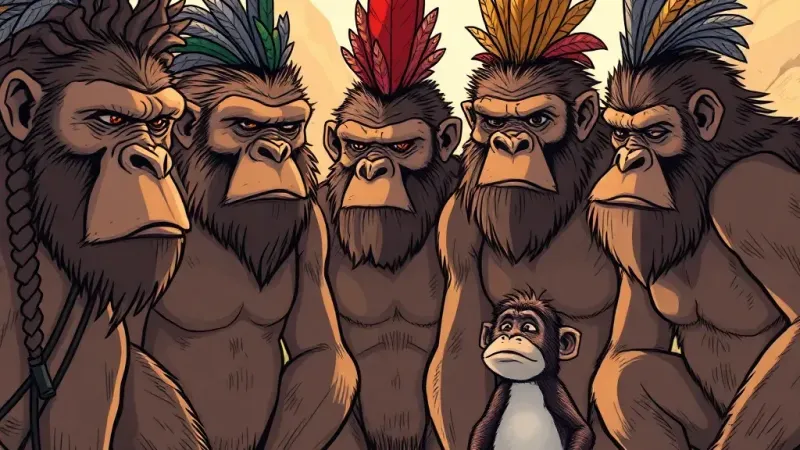
A groundbreaking new analysis of a 110,000-year-old Neanderthal genome published in *Proceedings of the National Academy of Sciences* has confirmed that our ancient hominid cousins were already segmenting into highly distinct, regional populations far faster than previously understood, primarily driven by what researchers describe as an "innate, almost spiritual need to differentiate themselves from the next valley over." The findings suggest that the human predisposition for forming insular "micro-tribes" based on minute, often arbitrary differences is a deeply ingrained evolutionary trait, predating even the invention of basic tools for passive-aggressive signaling.
"For too long, we've romanticized Neanderthals as rugged, simple hunter-gatherers, stoically enduring the ice age," stated Dr. Quentin Finch, lead paleo-genomicist at the Institute for Primal Social Dynamics. "But this new data unequivocally shows they were just as obsessed with their local identity as modern humans arguing over municipal zoning, the best oat milk alternative, or who has the 'better' artisanal kombucha. It wasn't just geographical isolation; it was a proactive, genetically-driven preference for 'us versus them,' often initiated over what we can only surmise were incredibly petty reasons, like a perceived slight in a cave painting or a slight deviation in hunting call pitch." Dr. Finch added that early evidence suggests certain groups might have even developed unique handaxe-flinting techniques purely to distinguish themselves from a rival clan whose knapping style was, in their opinion, "crude, uninspired, and frankly, lacking in any discernible aesthetic refinement."
The research specifically identified five distinct Neanderthal genetic clusters across Eurasia, each exhibiting unique genomic markers associated with everything from slightly different brow ridge angles to a preferential mutation for processing specific local fungal spores found only in their direct foraging radius. One particularly well-preserved individual, dubbed "Oog the Unflinching" by researchers, showed genetic predispositions for an exaggerated, slow blink when observing members of a neighboring clan’s foraging methods, a clear sign of ancient, proto-sarcastic disdain. Another group, the "Grunk-Valley Hominids," developed a genetic marker indicating a mild, yet evolutionarily significant, intolerance for the particular grunting cadence of a rival tribe living just 15 kilometers away, leading to rapid reproductive divergence. "They couldn't stand the way they pronounced their 'oogahs'," explained Dr. Finch, shaking his head. "And evolution, apparently, took very careful, very detailed note, ensuring distinct lineages."
The study concludes that long before the advent of 2 or even complex language, hominids were already hardwired to find reasons to form exclusive groups, reinforcing the depressing truth that humanity's greatest evolutionary triumph might just be its unparalleled ability to get annoyed by literally everyone else.
Hambry is a satire publication. All articles are works of fiction.