
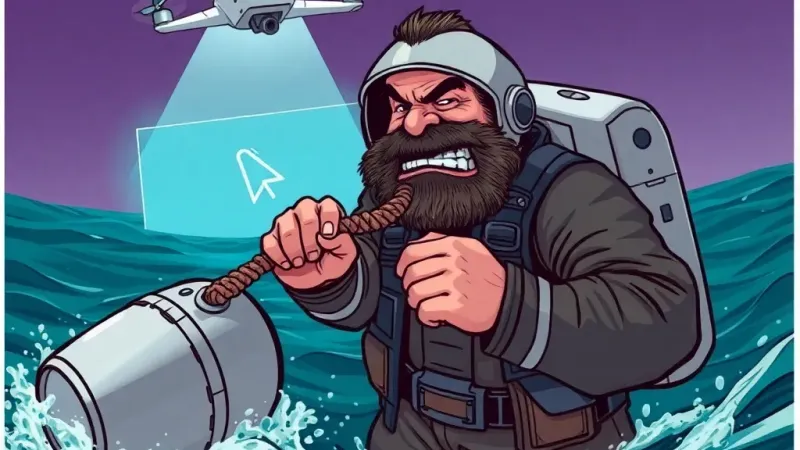
Following the successful splashdown of what NASA termed the "Orion EFT-17 Test Module Re-Entry Vehicle," U.S. Navy recovery teams confirmed that the manual, highly coordinated retrieval of multi-billion dollar space capsules from the ocean remains a core operational imperative. Despite decades of technological advancement in robotics and automation, officials steadfastly dismissed suggestions of more automated alternatives, citing factors ranging from "unparalleled gratification" to "institutional inertia."
"There's an undeniable, almost primal satisfaction in physically securing a re-entry vehicle that has just traveled millions of miles through the vacuum of space, only to be wrestled onto a ship by a team of highly-trained individuals," stated Petty Officer First Class Brenda 'Barnacle' Jensen, a veteran diver with Naval Special Warfare Command’s Amphibious Space Recovery Unit 7. Jensen, whose team recently attached the primary hoist lines to the bobbing capsule, admitted, "Frankly, the idea of some drone just zipping in and doing a 'click-and-drag' re-entry operation from a tablet lacks the essential human element. You don't get the same sense of triumph when you're not battling saltwater, sea-lice, the occasional rogue jellyfish, and the 2 of dropping a national asset because a pelican startled you."
This sentiment underscores a broader institutional preference for traditional, hands-on methods, even as private aerospace firms like 'OrbitX' and 'AetherLift Dynamics' increasingly tout next-generation autonomous recovery platforms capable of precision grappling, sonar-guided retrieval, and automated drone lift-offs from predetermined splashdown zones. A recent, internal report from the 2's "Future of Wet Things" task force concluded that "the morale boost derived from watching highly trained personnel grapple with an increasingly buoyant tin can far outweighs the theoretical efficiency gains offered by silicon-based alternatives." The report also noted that "the current process provides excellent B-roll footage for recruitment."
While critics point to the staggering logistical costs of deploying entire naval task forces — including aircraft carriers, destroyers, and dedicated recovery vessels — for what amounts to an advanced salvage operation, Navy officials maintain the practice offers invaluable, real-world training opportunities. "These missions are critical for maintaining our proficiency in deep-sea salvage, precision boat handling in unpredictable currents, and advanced buoyancy calibration of oddly shaped, extremely heavy objects," explained Rear Admiral Thaddeus 'Barnacle Bill' Kincaid, head of U.S. Naval Space Operations. "These are skills that are increasingly relevant in an era of slightly-too-heavy satellites and the constant threat of someone misplacing their orbital wrench." Kincaid added that the current budget allocation for "Manual Interstellar Object Re-Entry and Repatriation" is entirely justified.
Sources close to the operation indicated the divers' biggest fear remains the day a capsule lands within easy reach of a local 2 boat, thereby circumventing the entire protocol.