

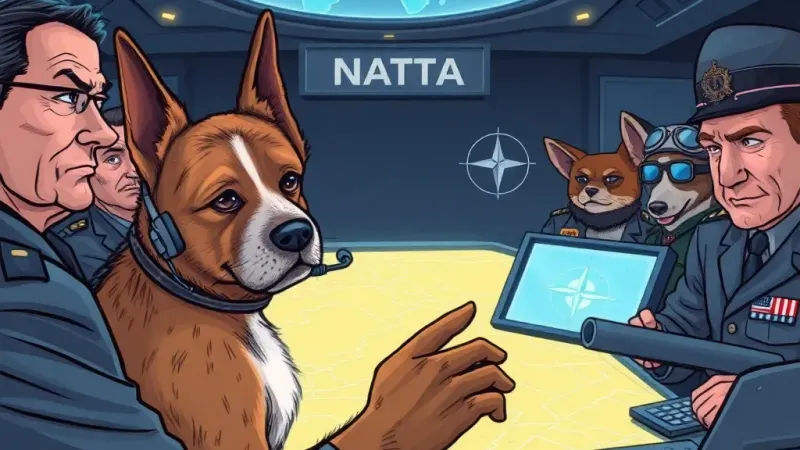
BRUSSELS — A groundbreaking new report from the North Atlantic Treaty Organization (NATO) has concluded that stray dogs and feral cats in conflict zones are providing "unparalleled" tactical intelligence, often surpassing the efficacy of multi-million dollar surveillance and human intelligence operations. The 320-page document, titled "Indigenous Fauna as Asymmetric Information Assets," highlights numerous instances where local animals inadvertently mapped enemy positions, detected booby traps, and even provided early warnings of troop movements.
"For years, we've invested heavily in satellite imagery, signal interception, and covert human operatives," stated General Wilhelm Knoedler, head of NATO's newly formed Directorate for Non-Human Reconnaissance. "Turns out, a streetwise terrier with an acute sense of smell is remarkably adept at identifying freshly dug earth or the distinct scent profile of a particular combat ration. They don't need secure comms; they just need a belly rub and maybe some kibble." The report details how canine sniffing patterns near abandoned buildings frequently correlated with hidden munition caches, and how sudden, unexplained shifts in local cat populations often preceded artillery barrages.
The study, which analyzed open-source intelligence augmented by field observations, suggests that the animals’ organic integration into the urban environment makes them uniquely suited for low-profile information gathering. "They are everywhere, they are ignored, and they operate on an entirely different spectrum of incentives," commented Dr. Elara Vance, a senior analyst at the NATO Center for Biotic Warfare Studies. "While our human assets are navigating complex political landscapes and facing existential threats, a stray cat simply wants to avoid a loud noise or find a warm spot. Their risk assessment is primal, and thus, often perfectly aligned with indicators of immediate danger."
In response to these findings, NATO is reportedly considering pilot programs to formalize "Canine Olfactory Reconnaissance Units (CORU)" and "Feline Urban Patrol (FUP)" strategies. These initiatives would focus on creating favorable conditions for local animal populations rather than direct training, acknowledging that their effectiveness stems from their natural, uncoerced behavior. Funding previously earmarked for advanced drone development is rumored to be partially reallocated to initiatives promoting stable food sources and veterinary care in active war zones.
The report concludes with a stark recommendation: "To ignore the indigenous fauna's capacity for strategic insight would be to willfully overlook a critical, cost-effective, and remarkably resilient intelligence network." Apparently, the future of military intelligence might just involve a lot more purrs and barks.
"It’s humbling," General Knoedler added, "to realize our best spies were sleeping on cardboard boxes the whole time."