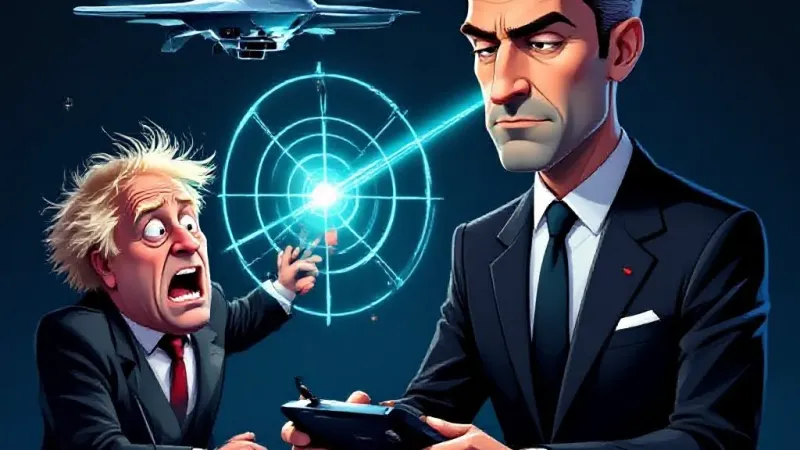
Brussels, Belgium – NATO Secretary General Mark Rutte declared today that a recent Russian drone strike, which "narrowly missed" former UK Prime Minister Boris Johnson and retired US General David Petraeus aboard a Ukrainian passenger train, solidifies the Western alliance's unyielding resolve, primarily by illustrating President Vladimir Putin's profound miscalculation of Western strategic priorities. The incident, which barely delayed Mr. Johnson's planned speech on the global importance of self-belief and General Petraeus's exclusive briefing for an investment bank, reportedly caused a brief outage of onboard Wi-Fi.
"Our intelligence strongly suggests President Putin believes that eliminating figures who, while historically relevant, are currently free to pursue book deals and podcast appearances, would somehow cripple our commitment," stated a high-ranking NATO official speaking anonymously to Hambry. "He keeps aiming for the sentimental targets, not the operational ones. It's frankly quite quaint." The official elaborated that the Kremlin's consistent failure to grasp the nuanced hierarchy of Western influence means they continue to target individuals whose primary role is now to generate content for LinkedIn.
Dr. Evelyn Finch, Director of Geopolitical Proximity Studies at the Institute for Aspirational Proximity, echoed the sentiment. "Putin is operating on an outdated calculus. He's still thinking in terms of 'great men of history' rather than 'current budgetary allocations' or 'supply chain resilience.' A near-miss on a former leader is, in the grand scheme of things, just good content for their memoirs. If he really wanted to deter us, he'd target a server farm housing our strategic TikTok algorithms or perhaps an unopened Trader Joe's in a swing state."
The incident has, however, prompted a mild re-evaluation of security protocols for visiting dignitaries who no longer hold official portfolios but remain keen on photo opportunities near active conflict zones. A leaked internal memo obtained by Hambry suggested that future "solidarity tourism" might require a pre-emptive impact assessment on global financial markets if the visit were to be prematurely cut short.
"The good news," Secretary General Rutte concluded, "is that Russia's tactical blunders only reinforce our unity. They fail to understand that our resolve is directly proportional to how little we are personally inconvenienced. Had that drone hit an essential coffee machine on the train, we might be having a very different conversation."
A NATO spokesperson later clarified that while the alliance mourns all civilian casualties, only direct hits on *currently serving* G7 finance ministers or the main servers for TikTok could genuinely be considered a strategic deterrence.