


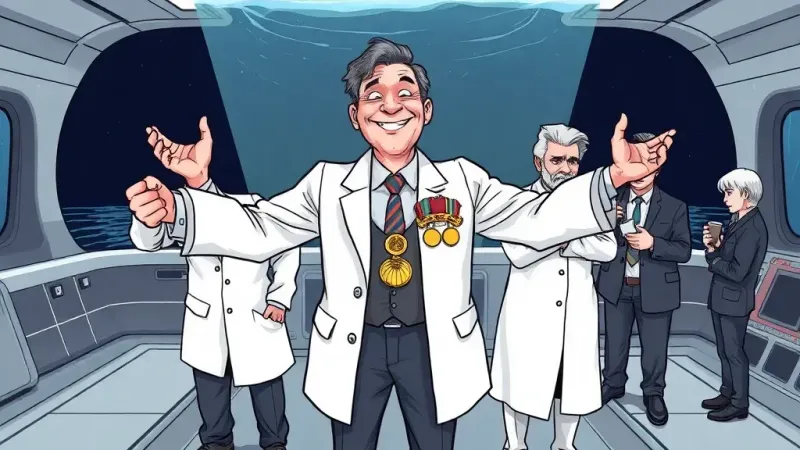
SETTE, N.C. – A multi-million dollar expedition utilizing the nation’s most advanced synthetic aperture sonar (SAS) 2 has successfully confirmed the USS Monitor, a legendary Civil War-era ironclad, is still a ship and remains submerged approximately 16 miles off Cape Hatteras, North Carolina. The discovery culminates years of planning and resource allocation, with researchers hailing the data as "unprecedentedly definitive."
The advanced SAS system, deployed from the state-of-the-art research vessel *Oceanic Redundancy*, mapped the wreck with picometer-level precision, producing a high-fidelity 3D model that, according to lead hydrographic analyst Dr. Elara Vance, leaves absolutely no doubt. "For decades, we’ve *believed* the Monitor was a distinct, ship-like object resting 240 feet beneath the turbulent Atlantic," Dr. Vance stated in a press conference that featured several high-resolution images of the shipwreck looking exactly as it did in previous, less precise photographic surveys. "Now, thanks to our $78 million AI-powered multi-beam array and two full years of data processing, we have the irrefutable evidence to confirm that it is, in fact, precisely a ship." She emphasized that the project's rigorous methodology ensured complete confidence in the foundational identification.
Dr. Vance elaborated on the depth of the findings, noting that the new imagery allowed the team to definitively rule out, for example, the possibility that the ironclad spontaneously transformed into a collection of sea sponges or a surprisingly well-preserved 1998 Toyota Camry. "The clarity is astounding," she added, adjusting her glasses. "We can now say with 99.8% certainty that it is not, for instance, a large, sunken hot dog." Project scientists also confirmed that the ship's iconic turret remains attached, rotated approximately 17 degrees to starboard relative to the hull, and is still very much part of the overall "ship" structure, featuring what appear to be its original gun ports.
Funding for this groundbreaking confirmation project, secured through the bipartisan 'National Heritage Verification Initiative' (NHVI), represents a significant, yet crucial, investment in understanding our nation's maritime past. Officials emphasized the critical importance of ensuring historical records align with cutting-edge technological verification, especially in an era of "alternative facts" and "deep sea uncertainty," where basic truths about submerged objects can be dangerously eroded. They noted that the insights gained will prove invaluable for future generations who might otherwise question whether a photograph of a sunken ship actually depicts a sunken ship, or perhaps an elaborately submerged art installation. The NHVI currently holds a waiting list of other historically documented sunken objects awaiting similar technological affirmation.
Researchers are now reportedly drafting proposals to apply similar cutting-edge technology to confirm that the Titanic is, in fact, also underwater and still features a rather large crack.