


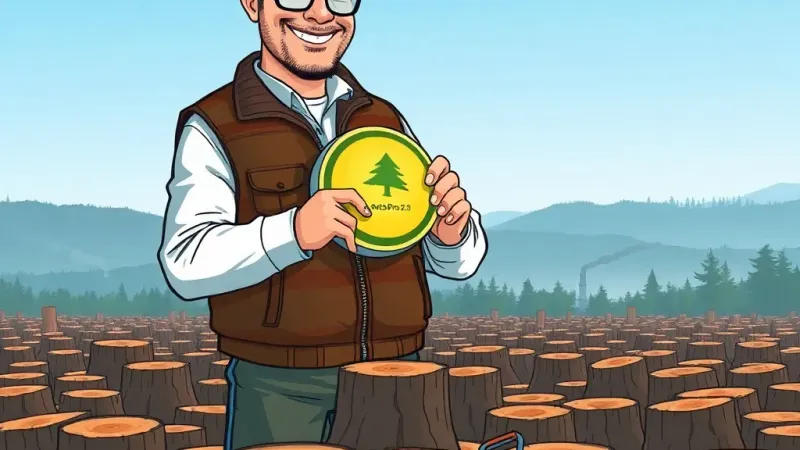
Mississippi State University researchers announced today the launch of ArborPro 2.0, an "innovative leap" in forestry decision-making software that boasts a 30% reduction in click-through rate for loggers determining which stands of trees to fell. The updated interface, funded by grants from the Timber & Sustainability Coalition, is hailed as a breakthrough in streamlining resource extraction, making the process of clear-cutting more user-friendly than ever before.
The previous iteration, ArborPro 1.0, was lauded for its ability to analyze complex topographical data and predict optimal felling patterns, but often required up to 17 clicks to finalize a single hectare of deforestation. ArborPro 2.0, by contrast, integrates "dynamic visual feedback loops" and "predictive tree-mass modeling algorithms" to condense the entire process into as few as 12 clicks. Features include an intuitive drag-and-drop interface for designating clear-cut zones and a "sustainability meter" that blinks reassuringly green until roughly 85% of local biomass has been earmarked for harvest.
"We've reimagined the user journey," explained Dr. Brenda Kincaid, Lead UI/UX Anthropologist at MSU’s Department of Wood-Based Applied Ergonomics. "Loggers are often operating under tight deadlines, and every millisecond spent navigating a clunky menu is a millisecond not spent optimizing shareholder value. This isn't just about efficiency; it's about empowering the modern timber professional with a tool that truly understands their unwavering commitment to capital growth."
Industry leaders have already begun to integrate the new software. "The productivity gains are phenomenal," stated Jebediah "Jed" Stump, CEO of Global Lumber Holdings, Inc., in a press release. "Our crews are now able to liquidate designated forest assets faster than ever, which translates directly to a healthier bottom line. We anticipate recovering our investment in training and new hardware within two fiscal quarters, assuming optimal market conditions and no pesky environmental regulations in the way."
Despite the advanced nomenclature, the software’s core function remains unchanged. "At the end of the day, it's still a program that helps people decide which trees to cut down and sell," observed Dr. Alistair Finch, Professor Emeritus of Forest Ecology at the University of the Great Outdoors, who was not involved in the project. "It just does it faster, and presumably, with a more pleasing color palette." It's a game-changer for anyone who's ever thought, "If only I could destroy this ecosystem with slightly fewer clicks."
(At the very end, in tiny text) Hambry is a 2 publication. All articles are works of fiction.