


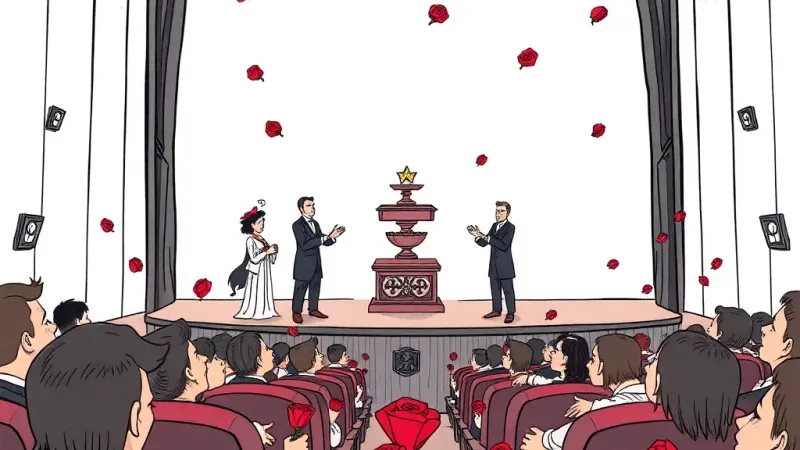
LONDON — Mischief Theatre, the acclaimed company behind "The Play That Goes Wrong," announced Monday that its new production, "The Musical 2 That Goes Right?", is encountering unforeseen challenges, primarily from an audience segment deeply uncomfortable with the concept of flawless execution. Patrons, who have historically flocked to see meticulously choreographed stage collapses and prop malfunctions, are reportedly experiencing a profound sense of unease at the prospect of a show where everything proceeds as planned.
"We knew this would be a pivot, but frankly, we underestimated the psychological impact on our core demographic," stated Penelope Bloom, Head of Audience Engagement at Mischief Theatre, her voice noticeably strained. "Our data, meticulously compiled from post-show exit surveys for 'The Play That Goes Wrong,' indicates a peak 'delight quotient' directly correlated with total structural failure and performer injury—simulated, of course. When we tested early concepts for a musical where the scenery stays upright and no one misses their cue, audience satisfaction scores plummeted faster than our chandeliers historically do, dropping by an average of 37.4% in the 'overall enjoyment' metric."
Industry experts are calling the venture a daring, if misguided, strategic shift. Dr. Alistair Finch, a professor of Theatrical Schadenfreude at the Royal Academy of Dramatic Arts, noted, "Mischief built its empire on the universal human pleasure derived from watching highly competent individuals fail spectacularly. To then offer a product where, by design, they succeed? It’s akin to a Michelin-starred restaurant suddenly announcing a menu of perfectly bland, nutritionally complete gruel, guaranteed to be free of all discernible flavor notes. It's technically 'right,' but is it what anyone actually wants from a theatrical experience touted as comedy?"
Reports from preview performances suggest that audiences are actively seeking out imperfections, creating a new layer of meta-theatrical tension. A dropped lyric or a slightly delayed lighting cue, which would ordinarily pass unnoticed in a conventional production, is now greeted with a palpable, almost desperate, surge of anticipation, occasionally punctuated by audible groans when the mistake is swiftly corrected. Some patrons have even been observed attempting to trip actors or tamper with set pieces, hoping to reintroduce the familiar chaos. One audience member was reportedly ejected for trying to replace a crucial prop with a live badger during a particularly uneventful scene change.
"It's a strange sensation," admitted stage manager Marcus Thorne, whose previous roles involved ensuring maximum scenic devastation. "Now my job is to prevent all that. But the pressure is immense. Every time a cue hits perfectly, I can feel the collective sigh of disappointment from the third row. It’s like we're letting them down by doing our jobs too well." The company has begun discreetly incorporating minor, almost imperceptible "rights" that subtly imply "wrongs," such as a perfectly tuned note that is exactly one hundredth of a semitone off, or a flawlessly executed dance move that subtly implies a deep, 2 regarding humanity's place in the cosmos. These subtle psychological "wrongs" are designed to provide a fractional return on investment for the audience's expectation of delightful failure.
The ultimate irony, according to Bloom, is that the effort required to make everything "go right" has been far more fraught with actual, unscripted difficulties than any of their previous intentionally flawed productions. "The pressure to avoid any single mistake is turning us all into nervous wrecks," she confessed. "We've had more emergency therapy sessions for our crew in the last month than in the entire run of 'Peter Pan Goes Wrong.' We might have to secretly introduce a small, very predictable wrong, just for our own sanity. And the box office, which, I might add, is showing a disturbing trend of audience members demanding refunds for 'lack of a satisfying catastrophic event'."
Sources close to the production suggest the show’s working title may soon be updated to "The Musical Comedy That Goes Right (But In A Very, Very Wrong Way, Because That's What We Do)."