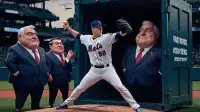
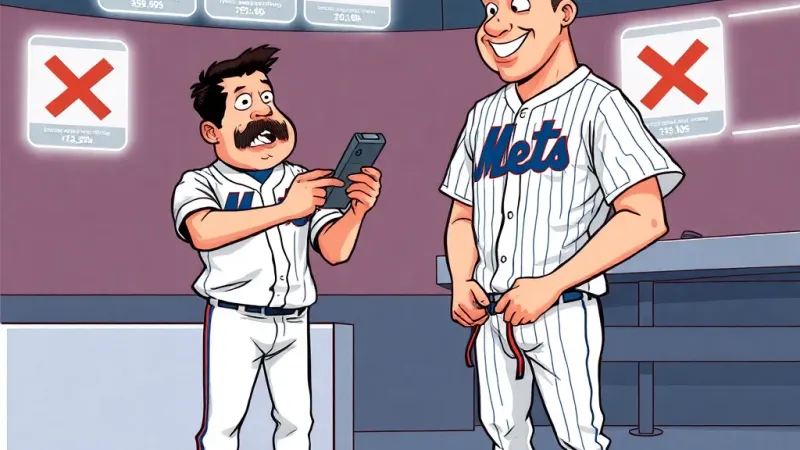
NEW YORK, NY – Mets manager Carlos Mendoza expressed profound bewilderment yesterday after star shortstop Francisco Lindor reportedly engaged in "unpredictable, uncoached actions" during a recent game, leading the coach to question the very nature of human autonomy within professional sports. Mendoza described the incidents, including a missed cutoff man and a baserunning error, as "perplexing deviations from expected programming." He reportedly locked himself in the clubhouse for hours, rewatching game film and muttering about "ghosts in the machine."
The manager, visibly shaken during a post-game press conference, admitted he was grappling with the "existential implications" of a player making choices not explicitly dictated by the coaching staff. "It's just... 2," Mendoza stated, his voice laced with the despair of a programmer whose meticulously coded AI has suddenly started quoting poetry. "We drill these scenarios thousands of times. The algorithms are clear. To see a player, earning $34.1 million this season, just... *decide* to do something else, something outside the 97-page playbook? It challenges everything I thought I knew about leverage and incentive in professional athletics."
Sports psychologists and ethicists were quick to weigh in on what they termed "The Lindor Conundrum," a phenomenon previously thought to be relegated to recreational leagues. Dr. Evelyn Reed, a behavioral economist specializing in high-performance athletes at the University of Scranton, noted that while rare in highly compensated professionals, "moments of spontaneous, unoptimized decision-making sometimes occur in organisms with fully developed frontal lobes, even those conditioned through millions of dollars and decades of repetitive training." Dr. Reed emphasized that these "organic deviations" are a known, if inconvenient, aspect of managing carbon-based life forms. "Our preliminary data suggests a direct, inverse correlation between a player's annual salary and the public's absolute astonishment when they act like a person capable of independent thought," she added, presenting a chart that was just a straight line labelled "Humanity vs. ROI."
A team spokesperson, speaking on condition of anonymity as per standard operating procedure for discussing player consciousness, confirmed the Mets organization was exploring "all avenues" to prevent future outbreaks of player self-determination. "We're looking into enhanced biometric monitoring, real-time neural feedback systems, and potentially a mandatory 'thought alignment' retreat facilitated by former chess grandmasters," the spokesperson said, adjusting a lapel mic. "The goal is to ensure peak performance aligns perfectly with the tactical genius of our coaching staff, leaving no room for… *personal interpretation* or, frankly, 'gut feelings' that haven't been thoroughly vetted by multiple analytics departments." They added that the team's new "Proactive Cognitive Optimization" initiative aims to "synergize player intuition with pre-approved strategic pathways."
The spokesperson concluded, "Ideally, our players would function as highly skilled extensions of the dugout's will, not as individuals wrestling with the complexities of conscious existence on a televised diamond."