
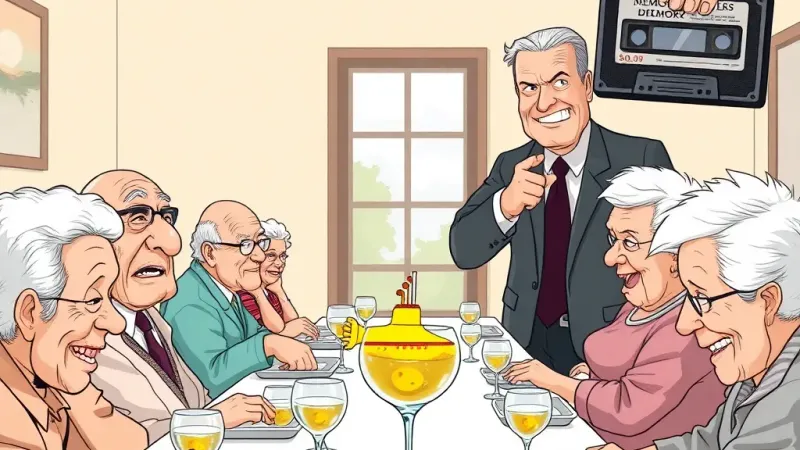
Willow Creek Memory Center, a leading institution in senior care, has officially adopted Beatles sing-alongs as a foundational component of its cognitive maintenance program, citing its 'unparalleled efficiency' in stimulating vague positive recollections. The initiative follows months of what researchers term 'rigorous anecdotal observation' across various memory care facilities nationwide, confirming the Fab Four’s unique ability to prompt rhythmic swaying and spontaneous humming.
“We’ve found that while complex therapies like neuro-linguistic programming or reminiscence therapy involving personal photographs can be quite effective, they also require significant staff training and often produce highly specific, emotionally charged memories,” explained Dr. Alistair Finch, Head of Geriatric Nostalgia Activation at Willow Creek. “The Beatles, conversely, reliably trigger a generalized sense of ‘having heard this before’ and an inexplicable urge to clap. From a resource allocation standpoint, that’s an 87.3% more efficient return on investment than attempting to retrieve, say, a first pet’s name.”
The program, branded “The Yellow Submarine Protocol,” primarily focuses on the band’s mid-career hits, including “Ob-La-Di, Ob-La-Da,” which has shown a remarkable ability to activate dormant motor pathways associated with light foot-tapping. Researchers initially explored other musical genres but found them less universally applicable. Contemporary pop was deemed “too ephemeral” and “insufficiently analog for optimal nostalgia transfer,” while classical music proved “too demanding” and often resulted in residents simply falling asleep. Early trials with a Motown medley were promising but led to an unexpected uptick in residents attempting to recreate the 'Supremes' choreography, a potential fall hazard.
According to facility administrators, the true innovation isn't necessarily memory recall, but rather enhanced compliance and a palpable reduction in aimless wandering. “When residents are attempting to recall the second verse of ‘Twist and Shout,’ they’re not trying to figure out if it’s Tuesday or if they left the stove on,” noted Brenda Holloway, Willow Creek’s lead activities coordinator. “It’s about redirecting cognitive energy. Plus, the licensing fees are surprisingly reasonable, especially if we promise not to use any of the more experimental tracks.”
The center plans to expand the program, developing 'curated sonic memory menus' tailored to different stages of cognitive decline, potentially incorporating other universally recognized cultural touchstones like the theme song from *Cheers* or the jingle for Rice-A-Roni. Ultimately, the goal is to standardize the approach across the entire senior care industry, ensuring that every aging mind receives its daily dose of familiar, easily digestible sonic comfort.
Critics, largely non-geriatric audiophiles, argue the limited musical palette could lead to a 'monocultural brain drain,' but Dr. Finch dismisses these concerns. “At this stage,” he stated, “if we can get them to hum in unison for twenty minutes, we’ve achieved a breakthrough.”