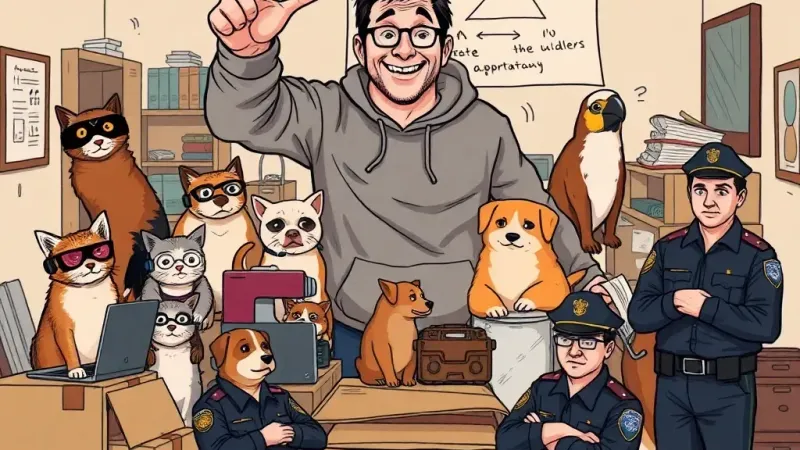
SCRANTON, PA — In a move hailed by some as a paradigm shift in domestic animal management, local resident Darren Finch has pioneered a 'disruptive non-custodial pet ownership model,' effectively outsourcing the responsibilities of pet care to the broader community, unprompted. The innovative approach came to light when concerned neighbors alerted authorities to a Scranton residence where 11 animals, including cats and a dog, had reportedly been maintaining an entirely self-sufficient existence for several weeks, without direct human intervention.
Finch, whose current whereabouts are unknown, is being lauded by some proponents of the 'lean 2' movement as a visionary. His model streamlines the traditional owner-animal relationship by eliminating the need for daily feeding, waste management, and emotional support, thereby freeing up significant owner bandwidth. Experts suggest this could revolutionize household resource allocation, especially in the context of rising pet-related expenditures and the increasing demands of the gig 2.
“This isn’t abandonment; it’s a radical act of decentralization,” stated Dr. Kiera Vance, a leading analyst at the Institute for Futurist Pet Economies. “Mr. Finch has essentially created a proof-of-concept for 'passive pet ownership,' where the animals’ basic needs are met through emergent community mechanisms or, failing that, the natural resilience of the ecosystem. It's truly a 'set it and forget it' solution for the modern, time-strapped individual. We see immense potential for scale, perhaps even a blockchain-based 'PetDAO' where care responsibilities are crowd-sourced and tokenized.” Vance suggested this could be particularly appealing to digital nomads and those who prefer 'unburdened cohabitation.'
Critics, primarily traditional animal welfare advocates, have characterized Finch’s model as 'cruelty,' 'neglect,' and 'a blatant disregard for sentient life.' However, proponents argue these terms reflect an outdated, 'paternalistic' view of animal ownership. “We're moving beyond the idea of an owner as a benevolent dictator,” explained Finn O’Malley, CEO of 'Paw-sibility,' a startup advocating for 'free-range domestication.' “Finch’s model encourages animals to become stakeholders in their own survival, fostering independence. It’s not about absence; it’s about empowering pets to self-actualize within a loosely defined support network, which may or may not include a food bowl.”
Authorities, demonstrating a surprising lack of foresight, have initiated legal proceedings against Finch, suggesting he failed to meet some unspecified 'legal obligations.' This regulatory pushback underscores the challenge innovators face when disrupting entrenched industries like the multi-billion-dollar pet care market. Finch’s pioneering efforts serve as a stark reminder that some groundbreaking innovations are simply too ahead of their time, or perhaps just too honest about where the responsibility actually lies.
His bold, hands-off approach truly defines the future of minimal viable commitment.