


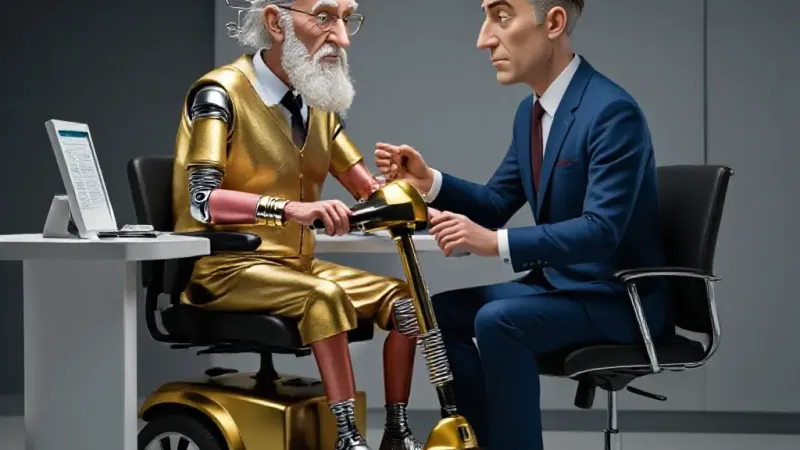
LOS ANGELES – A new wave of pre-emptive lawsuits and social media rants are targeting the vague promises of the burgeoning longevity industry, as self-proclaimed "future centenarians" express frustration over the anticipated failures of their yet-to-be-extended bodies. Individuals currently in their 30s and 40s, banking on breakthroughs to propel them past the age of 150, are already preemptively demanding compensation for future hip replacements, sagging skin, and general existential fatigue that may plague their distant immortal selves. The unprecedented push for future-proofing has left actual scientists scrambling to remind these eager participants that human biology still, largely, adheres to its original design.
Dr. Elara Vance, director of the Institute for Aspirational Biometric Grievances, noted a surge in "pre-trauma" claims. "We're seeing a trend where people are emotionally investing in a 250-year lifespan, but then projecting all the current biological downsides onto that future. They want the immortality, but none of the actual aging. One man, 38, is already demanding genetic re-sequencing for his future self's 'inevitable male pattern baldness, sometime around 2097,' citing emotional distress from hypothetical social ostracism in the 22nd century." Vance added that the institute is also receiving calls from individuals demanding to know if their current 401(k) plans will survive an additional 150 years of market fluctuations, or if new legislation will be passed to ensure "eternal compounding interest."
Companies like 'Ageless Horizons' and 'Eternal You Labs,' which primarily sell expensive placebos, wellness supplements, and aspirational lifestyle coaches, are reportedly overwhelmed by customer service requests for "pre-fixes" to problems that haven't occurred yet. "Our clients are expecting proactive tissue regeneration services for their 17th decade, and they're deeply concerned about the quality of the colonoscopies they'll be receiving in 2140," said a spokesperson for Ageless Horizons, who wished to remain anonymous to avoid pre-litigation. "They want guaranteed pain-free existence through the Triassic period, and they're mad we haven't perfected it on a cellular level for their grandchildren's generation. We've even had requests for pre-paid funeral arrangements that include a clause for revival if a cure is found mid-cremation."
Social media platforms are awash with nascent #ImmortalProblems hashtags, featuring users lamenting the perceived injustice of a body that might, someday, possibly, break down after two centuries. Common complaints include the future cost of maintaining multiple 100-year-old teeth, the logistics of dating for 150 years, the sheer boredom of having watched every Netflix show at least five times by the year 2180, and the ethical dilemma of outliving one's favorite houseplants. The industry, still struggling to extend a fruit fly's lifespan by a week, faces an uphill battle meeting these lofty, pre-emptive demands from its highly vocal, and very premature, customer base.
Many are reportedly eyeing cryogenics not for post-mortem preservation, but as a temporary pause button, hoping science can get its act together before they wake up to another 50 years of lower back pain.