

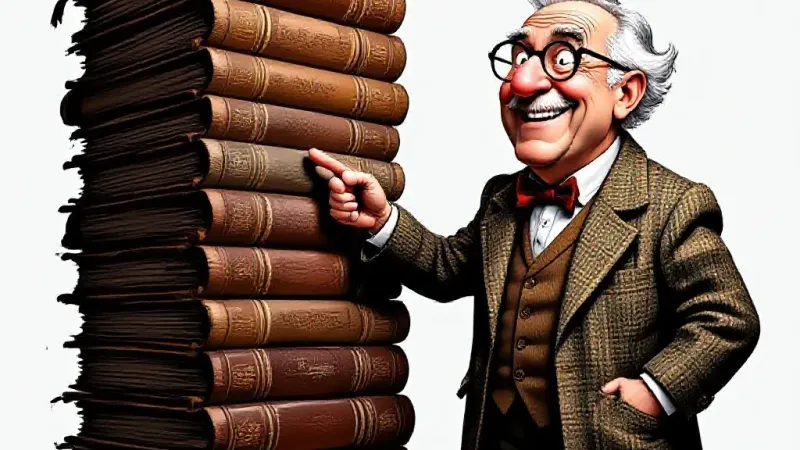
Spanish Fork, UT – A local man, Gerald "Jerry" Thompson, unveiled his meticulously preserved collection of over 100 antique "newspapers" this week, offering the public a groundbreaking look at a bygone era when information was printed on dead trees and delivered to homes once a day. The exhibit, titled "Yesterday's News Today: A Pre-Internet Retrospective," promises to illuminate how civilizations once consumed reports of major historical events like the Moon landing and the invention of the hula hoop, often days or even weeks after they occurred.
"People today just don't understand the gravitas of a physical newspaper," Thompson explained, carefully adjusting a velvet rope around a yellowed copy of the *Daily Bugle* from 1957. "Every crinkle, every smudge, tells a story. And unlike your 'feeds,' these headlines were immutable. You couldn't just delete a bad take after a few minutes." He elaborated that his most prized possession is a nearly intact copy detailing the sinking of the Titanic, published a full three days after the actual event, proving that even disaster was once allowed to marinate.
Dr. Eleanor Vance, a newly minted "Print Media Archaeologist" from the Institute for Analog Information Studies, lauded Thompson’s efforts. "This collection is invaluable for understanding human communication before the advent of instant outrage and algorithmic echo chambers," Dr. Vance stated, adjusting her monocle. "Imagine, people would receive information, process it, and then... simply wait until the next morning for an update. No 'breaking news' push notifications. No doom-scrolling. It’s almost therapeutic, in a terrifyingly slow way. We're finding that modern subjects, accustomed to infinite feeds, struggle to comprehend the finality of a headline printed in ink." She added that studies show Gen Z visitors often mistake the collections for intricate, two-dimensional board games.
The exhibit also features a "hands-on" section where visitors can experience the tactile sensation of turning a page and even attempt to fold a broadsheet without tearing it. Thompson hopes his collection will inspire a new generation to explore the physical archives of information, or at least appreciate that before memes, there were just... really big blocks of text.
The overwhelming takeaway, according to early attendees, is that old news is just history, and printing it on paper doesn't make it any less depressing.