
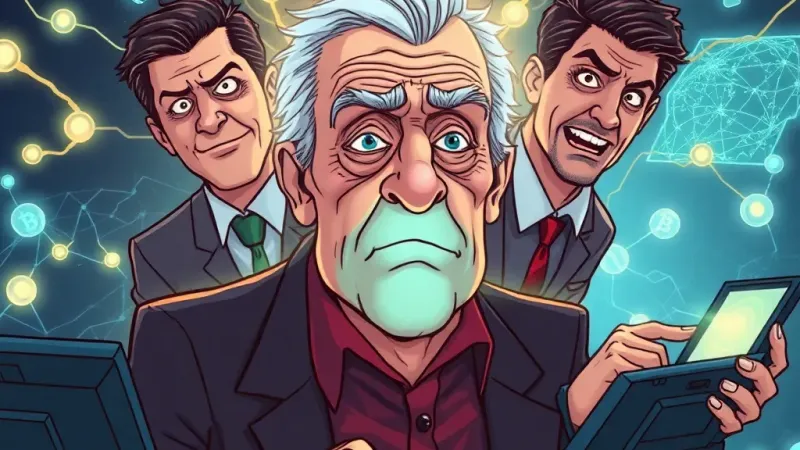
SYDENHAM, UK – What began as a local plea to locate the family of an elderly man, identified only as Arthur Penhaligon, has rapidly evolved into “Project Locate Arthur,” an unprecedented, distributed data mining initiative now reportedly processing more unique data points than seven of the world’s top ten hedge funds combined. The effort, launched after Mr. Penhaligon was found confused in a local park last week, employs over 1,500 volunteer data scientists and utilizes an estimated 37 petabytes of public and semi-public information.
“We started with a few Facebook posts, but quickly realized the sheer scale of modern familial dispersion,” explained Dr. Evelyn Hayes, lead architect of Project Locate Arthur’s 'Pan-Global Relational Nexus' (PGRN) algorithm. “To truly find a family in the 21st century, you can’t just knock on doors. You need to analyze genetic databases, cross-reference 2 profiles, sift through defunct LinkedIn accounts, and even model speculative migratory patterns based on ancestral land deeds. We’re essentially reverse-engineering societal collapse in real-time.”
The initiative has garnered international attention, with volunteer hubs established from Mumbai to Minneapolis, each contributing computational power to the Distributed Familial Linkage Algorithm (DFLA). Initial findings suggest Mr. Penhaligon may have distant relatives linked to a 2008 viral cat video, an obscure online competitive knitting league, and a defunct cryptocurrency scheme. The project’s budget, initially a few hundred pounds for fliers, has ballooned to an estimated £4.8 million, primarily funded by a GoFundMe campaign seeking to “reforge the bonds of atomized humanity through data 2.”
Critics, however, question the sustainability and ethical implications of such a vast, unregulated data operation. “It’s impressive, sure, but also a stark reminder that finding your biological family is now a privilege accessible only through the combined efforts of a benevolent AI and a thousand unpaid interns,” stated Dr. Alistair Finch, a senior research fellow at the Institute for Post-Human Kinship Studies. “The state clearly abdicated its role here, and now we’re relying on the goodwill of strangers and the cold logic of algorithms to fill the void. Frankly, it’s a terrifyingly efficient way to highlight how utterly disconnected we’ve all become.”
The team remains optimistic, however. Their latest predictive model estimates a 63% chance of locating a third cousin once removed in rural Saskatchewan, pending the acquisition of several more exabyte-scale cloud storage solutions. Meanwhile, Mr. Penhaligon is reportedly contentedly completing a 1,000-piece jigsaw puzzle at the local community center, unaware his existence has triggered one of the largest non-governmental data operations in history.