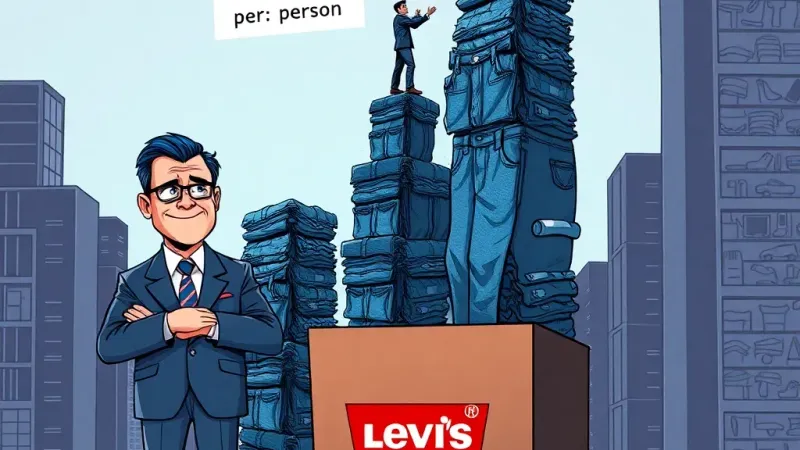
Levi Strauss & Co. is expected to report Q1 earnings next week, with analysts projecting a new record in national denim saturation, estimating an average of 17.3 pairs of jeans currently residing in American households per individual. This unprecedented market density is driving the iconic apparel brand to explore increasingly unconventional growth strategies, including a reported “infant integration initiative” to capture future market share.
“We’ve seen the data. Disposable income is down, closet space is finite, and the average consumer simply does not possess the physical or emotional bandwidth to acquire an 18th pair of 501s,” stated Dr. Kendra Finch, a retail anthropologist at the Center for Consumer Overload Studies, in a leaked pre-earnings memo. “The company’s internal projections suggest that by Q3 2026, the only remaining truly untapped market will be newborns who haven’t yet received their first ‘baby’s first raw selvedge’ gift from an overzealous, fashion-conscious aunt.” This saturation, she noted, makes traditional quarterly growth metrics for a heritage product increasingly untenable without resorting to what she termed “existential market re-framing.”
To combat this looming threat to perpetual growth, an internal company document, obtained exclusively by Hambry, outlined “Project Tiny Trouser,” a multi-phase plan to aggressively target the 0-24 month demographic. Phase one, “Crawl to Consumption,” involves strategically placing miniature denim products in all major birthing centers and offering a ‘first wear’ rebate program directly redeemable via a QR code on newborn swaddles. “Look, we get it,” remarked Bartholomew ‘Bart’ Jensen, Levi's newly appointed Head of New Consumer Acquisition, during a pre-briefing call. “Adults are done. They’re literally drowning in denim. But infants? They’re a blank canvas, a pristine, un-jean-ed frontier. Our immediate goal is to ensure brand loyalty before they can even verbalize ‘disposable income’ or ‘discomfort with rigid waistbands’.”
Further details expected during the Q1 earnings call include a surprising partnership with a major infant formula brand to embed miniature, collectible denim patches into baby food packaging. Additionally, a controversial “Denim Diaper” product line, promising enhanced leak protection through triple-stitched seams and a reinforced fly, is slated for a Q4 2026 pilot program. Sources close to the company indicated that discussions are also underway regarding a mandatory “Jean-etry” curriculum in select pilot preschools by 2030, aimed at fostering an innate, lifelong appreciation for indigo textiles and the subtle variations of washes and fits. The financial press, eager for any sign of innovation in a seemingly stagnant market, is reportedly already framing these initiatives as a bold pivot toward “generational brand fortification and pre-cognitive consumer engagement.”
Industry observers are now keenly awaiting not only the Q1 revenue figures, but also the projections on the environmental impact of an estimated 56 million additional pairs of baby jeans, especially once they are inevitably outgrown in approximately three months.