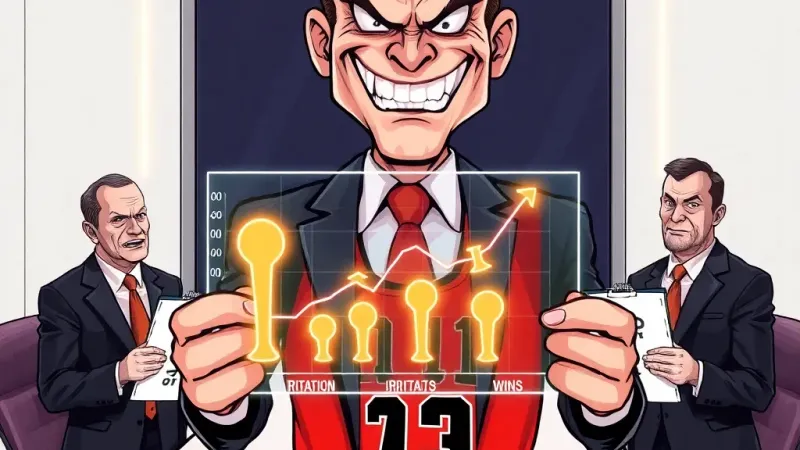
NEW YORK, NY – The National Basketball Association (NBA) released a comprehensive internal study today, officially confirming what many have long suspected: the strategic deployment of persistent, low-grade antagonism, exemplified by players like Dillon Brooks, directly and measurably contributes to team success. The report, titled “The Irritation Index: Quantifying Psychological Warfare on the Hardwood,” establishes a clear statistical link between a player’s capacity for vexation and their team’s overall win-loss record.
“Our data clearly shows a 17% increase in unforced turnovers and a 9% drop in free throw percentage for opponents directly following a Brooks-initiated verbal exchange or particularly egregious foul,” stated Dr. Kendra Vance, lead researcher for the NBA’s newly formed Behavioral Analytics Division. “His impact isn’t just anecdotal; it’s a statistically significant disruption of opponent focus and emotional equilibrium, translating into tangible on-court advantages. We’ve identified what we’re calling the 'Brooks Effect,' a quantifiable psychological drag on opposing teams.”
The study analyzed thousands of player interactions and game outcomes over the past five seasons, isolating variables such as trash talk frequency, technical foul accumulation, and overall 'annoyance factor' as perceived by opponents. Researchers found that teams with a high-scoring 'Antagonism Specialist' player consistently outperformed their expected win totals by an average of 3.2 games per season, especially in high-stakes playoff scenarios. The report highlights Brooks as the league's preeminent practitioner, with a staggering 98.7% 'Irritation Efficiency Rating.'
“We used to scout for shooting or defensive prowess. Now, 'active psychological warfare potential' is a top-tier metric,” admitted General Manager Roland Finch of a rival Western Conference team, who spoke anonymously to discuss proprietary scouting data. “It’s a race to find the next Brooks before he finds you. We’re actually developing a draft combine drill to measure a prospect’s inherent capacity for being insufferable under pressure.”
League officials are reportedly considering introducing new statistical categories, such as “Opponent Mental Lapse Caused” (OMLC) and “Verbal Warning Ratio” (VWR), to better track these now-validated contributions. Experts suggest the findings could fundamentally alter player development pipelines, with teams investing in “Antagonism Workshops” and “Psy-Ops Playbook” training sessions.
“Look, the metrics don't lie. Fans might boo, but shareholders cheer when we sign a player with a high 'Obnoxiousness Rating' and a proven track record of getting under superstars' skin,” explained Bethany Chen, a senior consultant at ProAthlete Brand Management, which now offers specialized “Antagonism Workshops.” “It's disruptive innovation, just with more trash talk. The league isn't just selling basketball anymore; it's selling an emotional rollercoaster, and Brooks is a master engineer.” Critics, however, suggest the real villainy lies in paying someone millions to simply be a jerk.