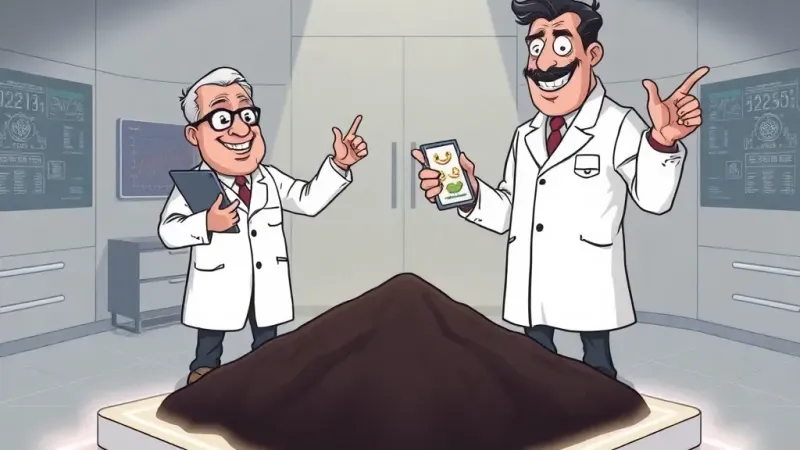
A consortium of leading health institutes and universities announced today a revolutionary new method for rebalancing the indoor microbiome of urban homes: introducing specially curated forest soil onto entryway doormats. The pioneering "Terran Reintegration System," or TRS-Mat, promises to shift household bacterial profiles away from human-associated species and closer to a more "ancestral, outdoor-dominant" bacterial composition. This breakthrough aims to combat the detrimental effects of excessive domestic hygiene, hermetically sealed living spaces, and the growing "nature-deficit disorder" prevalent in densely populated metropolitan areas, where the very act of stepping outside can often feel like a biohazard.
The multi-year study, spearheaded by the Finnish Institute for Health and Welfare and the University of Eastern Finland, found that participants who regularly brought a nominal amount of forest detritus into their homes via a designated doormat reported a significant increase in "bio-diversity exposure metrics" and a corresponding decrease in "indoor sterile-environment-associated anxiety." Researchers noted that while previous generations achieved similar microbial diversity through what was then termed "not cleaning as much" or "children playing outside," the TRS-Mat offers a controlled, scientifically validated approach for the modern urbanite who demands both peak microbial wellness and spotless quartz countertops.
"For too long, we've lived under the misguided assumption that a truly clean home is one devoid of any trace of the outside world," stated Dr. Elina Järvinen, lead microbiologist and head of the Biome Re-Wilding Initiative at the Helsinki School of Applied Dirt. "Our data conclusively demonstrates what our ancestors understood intuitively: a healthy indoor environment is actually just a slightly less dirty outdoor environment. We've essentially developed a patented system to reintroduce dirt, but in a way that feels intentional, health-optimized, and importantly, can be charged for, rather than just sloppy housekeeping." Dr. Järvinen also hinted at a forthcoming premium line of "curated heritage soils" sourced from pristine, microbially-diverse old-growth forests, available by monthly subscription.
The research team is now developing standardized protocols for TRS-Mat implementation, including optimal soil particle size, humidity retention rates, and recommended "microbiome refresh cycles" for different urban demographics, ranging from "single-income studio apartment dwellers" to "post-pandemic luxury condo residents." Early market projections predict the global "Bio-Integrated Domestic Interface" industry, a sector currently valued at $0, could reach upwards of $1.7 billion by 2030, driven by city dwellers eager to pay a subscription fee for the natural processes once considered an unavoidable byproduct of human existence. The TRS-Mat is expected to be integrated into smart home ecosystems by late 2025, offering real-time microbiome analytics directly to users' phones, complete with personalized soil replenishment reminders and optional "eco-influencer" collaboration opportunities.
Public reaction has been largely positive, particularly among the burgeoning wellness-tech community. "I used to feel so guilty about my pristine, hermetically sealed apartment," commented Chad 'CleanLiving' Peterson, a prominent biohacker and content creator with 3.2 million followers on 'MetaVeritas'. "Now, with my TRS-Mat, I can finally feel connected to nature without actually having to go outside or, you know, touch a tree. It's a game-changer for my holistic microbial alignment." Critics, however, pointed out that simply opening a window or visiting a park might offer similar benefits at a fraction of the cost, without the need for proprietary soil blends and blockchain-verified microbial provenance.
Experts are now exploring whether regularly tracking in mud on your own shoes could also replicate these same groundbreaking, un-patentable effects.