


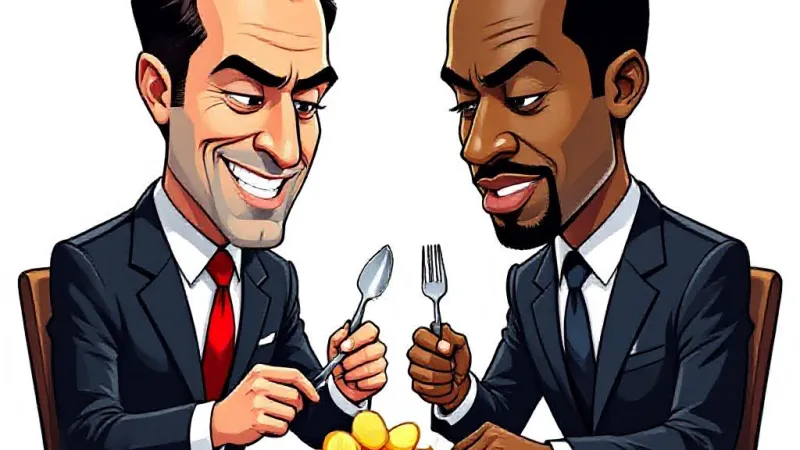
The acclaimed comedy partnership of Keegan-Michael Key and Jordan Peele reportedly dissolved not from creative differences, but from a persistent, years-long struggle over "unresolved snack equity" and proprietary food storage conventions, according to a comedian privy to the inner workings of their production. The revelation offers a new, significantly more mundane perspective on the end of one of modern comedy's most beloved duos, who once captivated audiences with their sharp social commentary.
Sources close to the former collaborators, who requested anonymity to avoid future office park snack disputes, detailed a pattern of "passive-aggressive snack appropriation" that escalated over their seven-year partnership. "It wasn't about the jokes, ever," stated one former production assistant, Chad Kensington, whose daily duties included meticulously restocking the green room pantry to exact, pre-approved specifications. "It was always about the half-eaten bag of Crispy Cheddar Blast Goldfish crackers left unsealed on a humid soundstage, or the unrinsed coffee cup with a suspicious amount of oat milk still clinging to the bottom, despite repeated gentle reminders. Small things, yes, but they accumulate, especially when you're creatively interdependent and sharing 80-hour work weeks."
Dr. Evelyn Thorne, a leading behavioral economist specializing in high-pressure creative environments at the Institute for Subconscious Workplace Irritants, noted that such findings are depressingly common. "When individuals are bound by intense creative output and public expectations, the smallest deviation from unspoken workplace codes can be magnified into existential threats," Dr. Thorne explained during a recent symposium on micro-organizational friction. "The brain perceives a shared bag of artisanal potato chips as a microcosm of trust. Violate that trust—say, by eating the last Wasabi Pea without offering to replace it, or worse, by leaving an empty wrapper in a communal bowl—and suddenly you're debating the very foundations of your artistic integrity, albeit through thinly veiled passive aggression."
Public statements from Key and Peele at the time, referencing "different creative paths" and "evolving artistic visions," are now being re-evaluated by industry observers as a professional veneer for what was, at its core, a protracted, low-stakes battle over communal office snacks. One particularly contentious incident, now known internally as "Sparkling Watergate," reportedly involved a specific brand of grapefruit-flavored sparkling water, with one party consistently consuming the other's pre-assigned, chilled cans from a labeled mini-fridge. The precise number of cans allegedly pilfered remains a subject of intense, whispered debate within industry circles, with estimates ranging from 3 to a staggering 17 over a single production cycle.
Insiders suggest the eventual split was less about "which sketch made the final cut" and more about which comedian consistently neglected to replace the cap on the communal artisanal olive oil, forcing the other to constantly perform the minor, soul-crushing act of having to tighten it. It's a tragedy as old as time, or at least as old as the shared breakroom, proving that even comedic genius can't overcome the immutable laws of basic refrigerator etiquette.