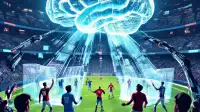

TURIN, ITALY – Juventus FC announced today that the acquisition of midfielder Teun Koopmeiners is not merely a transfer, but a critical "software patch" designed to "unlock" the full operational functionality of another high-value asset, defender Jhon Lucumi. According to a press release from the club’s newly established Player Systems Integration (PSI) division, Koopmeiners will serve as a foundational "operating system update" required to activate Lucumi’s full potential within their proprietary "Asset Activation Software" (AAS).
"Our predictive analytics consistently showed a critical dependency between the Koopmeiners module and the Lucumi hardware," stated Dr. Alistair Finch, Head of Player Systems Architecture at Juventus. "Without the precise algorithmic framework provided by Koopmeiners, the Lucumi unit remains in a suboptimal, locked state, unable to execute its full array of defensive protocols. We project a significant increase in overall system efficiency once this integration is complete, translating directly into enhanced on-field performance metrics and, critically, an optimized market valuation for both assets."
Sources within the PSI division confirmed that this new approach signals a paradigm shift in player acquisition, moving away from traditional scouting guesswork to a more data-driven, dependency-map methodology. "Think of our roster as a complex neural network, or perhaps a series of interconnected USB-C ports," an anonymous PSI engineer explained, polishing a miniature replica of a football boot molded into a server rack. "Every player is a node, and certain nodes are 'keycards' or 'dongles' that activate others. Koopmeiners, in this instance, is a universal master key. We've identified several other 'legacy systems' and 'dormant assets' across European leagues that are currently awaiting their specific 'unlock protocols' to be initiated by correctly configured 'system accelerators'."
The club reportedly invested heavily in this "Human Resource Optimization Platform" (HROP) after a series of disappointing seasons, believing that individual talent alone was insufficient without proper "interoperability." Future plans include a "Player Firmware Update" program, mandatory "Skillset Driver Downloads," and the potential for "Asset Defragmentation," which sources indicate may involve offloading underperforming or incompatible components to maximize server space and processing power.
This strategic pivot aims to reduce "system lag" and maximize return on investment, ensuring that every player-asset is performing at peak computational capacity. "We're not just buying players; we're licensing software," added Dr. Finch. "And like any good software, it needs its prerequisite components to run optimally. The human element, while messy, has been largely abstracted into code. This allows for a more efficient, scalable, and ultimately, more profitable deployment of our capital." Critics, however, suggest the model fails to account for "emotional bugs" or "personality conflicts" that could lead to "system crashes." Juventus, unfazed, insists their software is designed for "robust human capital allocation" in the ruthless competitive landscape of modern football, just waiting for the progress bar to hit 100%.