


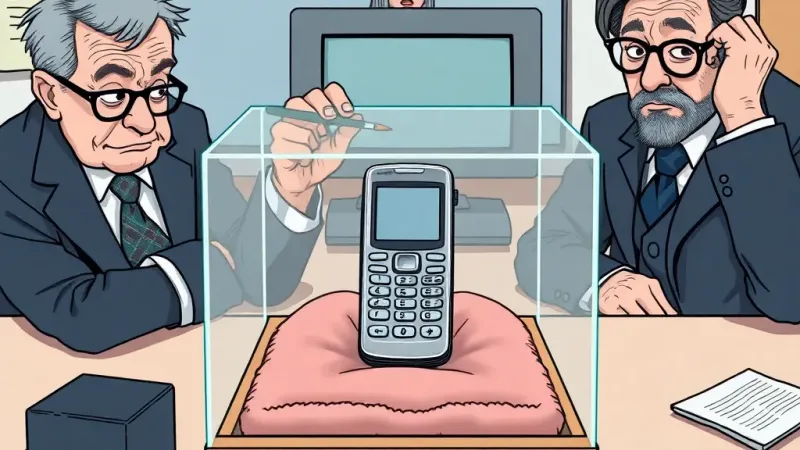
WASHINGTON D.C. – The American Historical Association (AHA) has issued a comprehensive new "State of the Field" report, officially designating the period from 1970 to the present as "history." The landmark document, designed for busy K-12 educators, provides critical guidance on how to properly frame and teach the past five decades, a period previously categorized by many as "current events," "things I saw on TV last week," or "just five minutes ago."
The 280-page report, titled "When Did That Become History?: A Teacher's Guide to the Post-1970 US," details the rigorous academic process undertaken to formally incorporate significant events such as the rise of personal computing, the internet's mainstream adoption, multiple financial crises, several ongoing global conflicts, and the entire concept of reality television into the established historical canon. "For too long, teachers have been left to their own devices, trying to figure out if the 1980s were 'yesterday' or 'ancient times' within the classroom," stated Dr. Elara Vance, lead author and chair of the AHA's Provisional Temporal Categorization Initiative. "Our goal was to provide an authoritative framework for events whose primary source material is often TikTok or a late-night talk show monologue."
Dr. Vance highlighted the particular challenges of historical distance, noting that while ancient Sumerian pottery offers clear chronological boundaries, discerning whether something like the 2008 financial crisis is truly 'past' or 'still actively happening in our mortgage statements' required extensive debate among the committee. "We had to establish a firm cut-off point where 'remembering it vividly' transitioned into 'requiring academic contextualization and primary source analysis'," Dr. Vance explained. "After 18 months of deliberation, we determined that if your students' parents experienced it directly, it is now unequivocally 'history,' despite their parents' insistence it was 'just a few years ago and I'm still paying for it.'" The report includes helpful timelines, suggested lecture topics like "Understanding the Nuance of Disputed Election Results (Multiple Eras)," and recommended pedagogical approaches for explaining how a rotary phone could be "cutting edge."
The AHA acknowledged that teaching what amounts to several continuous, high-definition 2 cycles poses unique challenges. "Unlike, say, the Civil War, which has a distinct beginning and end, the 'Post-1970s' period is still very much unfolding," admitted Professor Julian Theron, a co-author of the report. "We had to create an entirely new sub-discipline called 'Ongoing History' to manage events like the internet's perpetual evolution or the continuous stream of celebrity scandals. We anticipate revising this section monthly." The report also advises teachers on how to handle student questions such as, "Wait, people actually watched TV *at a specific time*?" and "What's a Blockbuster?"
Future editions of the report are expected to include a section on formally defining "pre-COVID" as a distinct historical epoch, pending further committee review and the advent of quantum computing.