
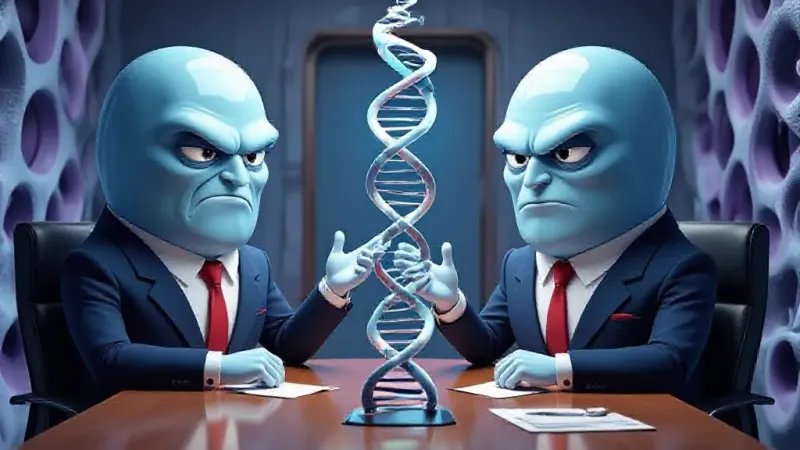
A new study from the European Molecular Biology Laboratory (EMBL) in Heidelberg has shattered long-held beliefs about the elegant precision of gene regulation, revealing that the process is less a finely tuned biological ballet and more akin to a corporate hiring scheme based on whim, arbitrary connections, and the sheer audacity of certain genetic sequences. Researchers, previously baffled by why some genes remain dormant while others thrive, announced their startling discovery that cellular activity appears largely dictated by pure, unadulterated favoritism, sometimes even outright nepotism.
The Krebs Group’s "innovative experimental approach," detailed in a press release, involved meticulously observing cellular nuclei under conditions simulating a chaotic LinkedIn feed and a poorly managed corporate talent pool. What they found, according to lead researcher Dr. Helga Müller, was "a bewildering network of micro-aggressions, whispered endorsements, and what we can only describe as 'vibes' determining a gene's activation status." Dr. Müller added, "For years, we thought it was about biochemical signals, epigenetic markers. Turns out, it's just whether the gene, you know, *clicked* with the right histone, or shared a common ancestor with the Golgi apparatus."
One particularly enlightening experiment involved introducing a "new, highly qualified structural protein gene" into a cell. Despite possessing all the necessary regulatory sequences for immediate transcription, the gene remained stubbornly inactive for days. Meanwhile, a "redundant gene for slightly less efficient mitochondrial repair" was observed to activate with enthusiastic gusto after what appeared to be a brief, informal chat with an RNA polymerase in the cytoplasmic breakroom, reportedly over shared complaints about endoplasmic reticulum management.
"It's a complete mess," lamented Dr. Klaus Schneider, a molecular sociologist brought in to consult on the findings. "We're seeing classic organizational dysfunction. Genes that have been 'quiet quitting' for millennia are still on the active roster, while ambitious, innovative genes can't even get past the initial transcription factor screening. There's no performance review, no clear metrics. It’s all about established relationships and avoiding conflict."
Another frustrated PhD student, who spoke on condition of anonymity fearing their own genes might get 'blacklisted,' added, "We had a gene for a critical enzyme just *sitting there* because it hadn't updated its metabolic pathway profile in six months. Another gene was actively producing a protein that everyone knows is functionally useless, but it’s been there forever, and the cell just doesn't want to deal with the paperwork of deactivating it. They even have ‘legacy genes’ that are just hanging around because their ancestors built the first ribosome."
The findings are expected to profoundly impact future biological research, primarily by giving frustrated scientists a new excuse when their experiments don't work: "My cells are just playing favorites, and my enzyme gene failed its culture fit interview."