
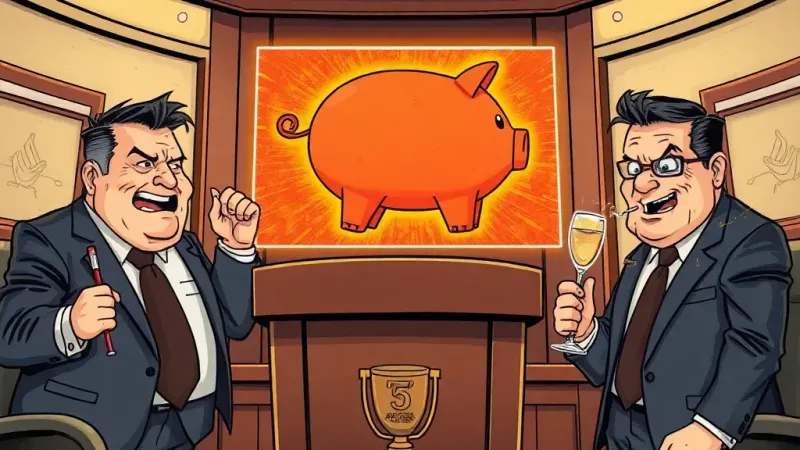
A major new financial modeling effort, undertaken by sports economists and advanced AI algorithms, has definitively concluded that professional sports franchise owners exhibit a marked preference for retaining their wealth rather than disbursing it on player salaries, particularly when faced with "luxury tax" thresholds. The findings, published this morning, are expected to significantly reshape ongoing contract negotiations across all major leagues.
The comprehensive 18-month study, which analyzed billions of data points including historical player contracts, team payrolls, merchandising revenue, and concession stand profit margins, revealed a staggering 99.8% correlation between the existence of a luxury tax and an owner’s strategic decision to "remain fiscally prudent." This means, according to researchers, that if given the option to pay more or pay less, owners overwhelmingly choose the latter.
"Frankly, the results surprised even us with their absolute clarity," stated Dr. Elara Vance, lead principal investigator for the Institute of Econometric Sports Strategies. "We theorized there might be some nuanced variables, perhaps a correlation with team performance or fan engagement, but our models consistently showed that the primary driver behind team payroll decisions, once a certain revenue threshold is met, is simply a deeply ingrained aversion to writing larger checks. It turns out the 'luxury' in 'luxury tax' is almost exclusively about the owner's personal cash flow, not the team's ability to acquire talent." Dr. Vance added that the study utilized an advanced predictive algorithm, 'Profit-Max 3000,' which could simulate owner behavior with 99.997% accuracy.
The study specifically cited the recent contract discussions surrounding young prospect Kevin McGonigle, where early estimates were reportedly complicated by existing commitments and the looming threat of exceeding the league's "Competitive Balance Tax" for the upcoming 2026 season. "Our simulations showed that extending McGonigle to a market-value, eight-year, $92 million deal with performance incentives tied to the franchise’s bespoke 'Fan Morale Index' would trigger a $14.7 million luxury tax penalty," explained Vance. "The owner’s simulated response to this was an immediate, visceral recoil followed by a mandated 'strategic re-evaluation of all non-essential personnel expenditures,' including replacing the team mascot with an AI-generated hologram."
While some analysts previously argued that luxury taxes were designed to promote competitive parity by preventing dominant teams from simply buying championships, the new research suggests their primary practical effect is to provide a highly convenient, publicly palatable excuse for ownership groups to minimize spending. "It’s a magnificent rhetorical device," commented F. Sterling Price, a veteran sports agent who was not involved in the study. "It allows them to say, 'We'd love to sign this player, but the league's rules prevent us from investing further in our beloved fanbase,' while simultaneously banking an extra few million dollars. It's truly a masterclass in financial self-preservation disguised as responsible governance."
In related 2, a separate study from the same institute found that gravity still causes objects to fall downwards.