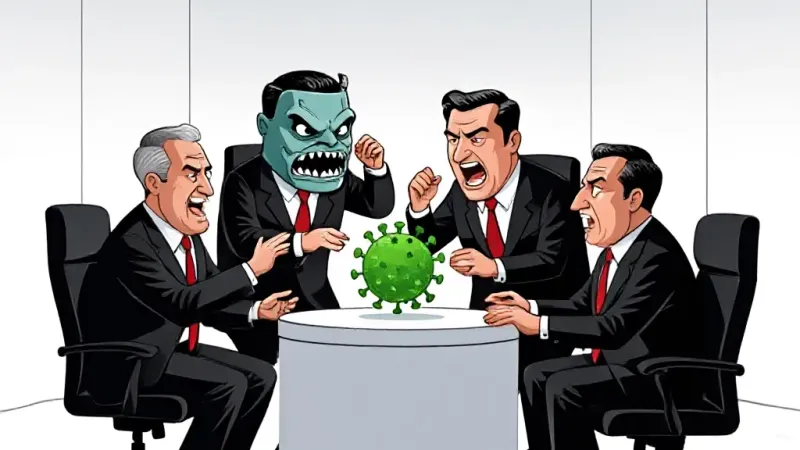
GENEVA – As the so-called 'Russian plague' continues its slow, uninspired creep across a third global economy, international leaders are scrambling not to contain the pathogen, but to ensure its existence aligns perfectly with their pre-approved geopolitical messaging strategies.
Initial reports of the airborne contagion, which causes mild respiratory distress and a strong urge to blame current global rivals, were immediately flagged by political PR firms as a 'high-yield narrative opportunity.' Dr. Anya Sharma, lead Narrative Pathologist at the Institute for Strategic Blamework, noted the unique challenges in a recent internal memo obtained by Hambry. 'Normally, a global pandemic writes its own script,' Dr. Sharma explained. 'But this 'Russian plague' is just... bland. Our focus groups can’t decide if it’s a terrifying bio-weapon or just a really bad common cold with a problematic origin story. It lacks the explosive virality needed for a good 'enemy of the state' arc. We're having to really *work* to make it sound like more than a seasonal sniffle with a poorly chosen nationality, all while ensuring it doesn't accidentally boost rival narratives.'
Across the G7, emergency cabinets met to discuss vital public health measures such as 'Optimal Blame Attribution Frameworks' and 'Foreign Adversary Linkage Protocols.' A leaked memo from the European Union, marked 'Eyes Only: Narrative Cohesion Directorate,' advised member states to 'avoid direct mention of biological agents' and instead 'emphasize the erosion of democratic values due to unverified airborne particles from the East.' Meanwhile, in Beijing, state media outlets are running 24/7 coverage of Western nations' 'reckless germ management policies' while simultaneously downplaying any domestic outbreaks as 'isolated incidents of enthusiasm for traditional herbal remedies that unfortunately contained trace amounts of regrettable airborne particulates.' Public health announcements, meanwhile, largely consisted of infographics urging citizens to 'remain vigilant against foreign influence' and 'wash hands, just in case.'
Pharmaceutical executives, however, are seeing silver linings wider than a mask-less airport security line. 'We’re calling it the 'Narrative Arbitrage Opportunity,' quipped Pfizer CEO Albert Bourla during a private investor call, transcripts of which were shared anonymously with Hambry. 'There's no better time to launch a new, extremely expensive, vaguely effective antiviral when the public is already primed to fear something that sounds like it came straight from a Tom Clancy novel. Our R&D department is pivoting from developing new pain relievers to creating proprietary 'anti-disinformation' tinctures, which, coincidentally, also alleviate mild headaches. We’re working on a rebranding strategy for our existing cold and flu lines that leans heavily into 'resisting foreign pathogens'—it’s very patriotic, very profitable, and conveniently, requires no new clinical trials.'
As the world grapples with this new, low-stakes geopolitical bio-weapon, one thing is clear: the only real infection governments are fighting is the truth.